
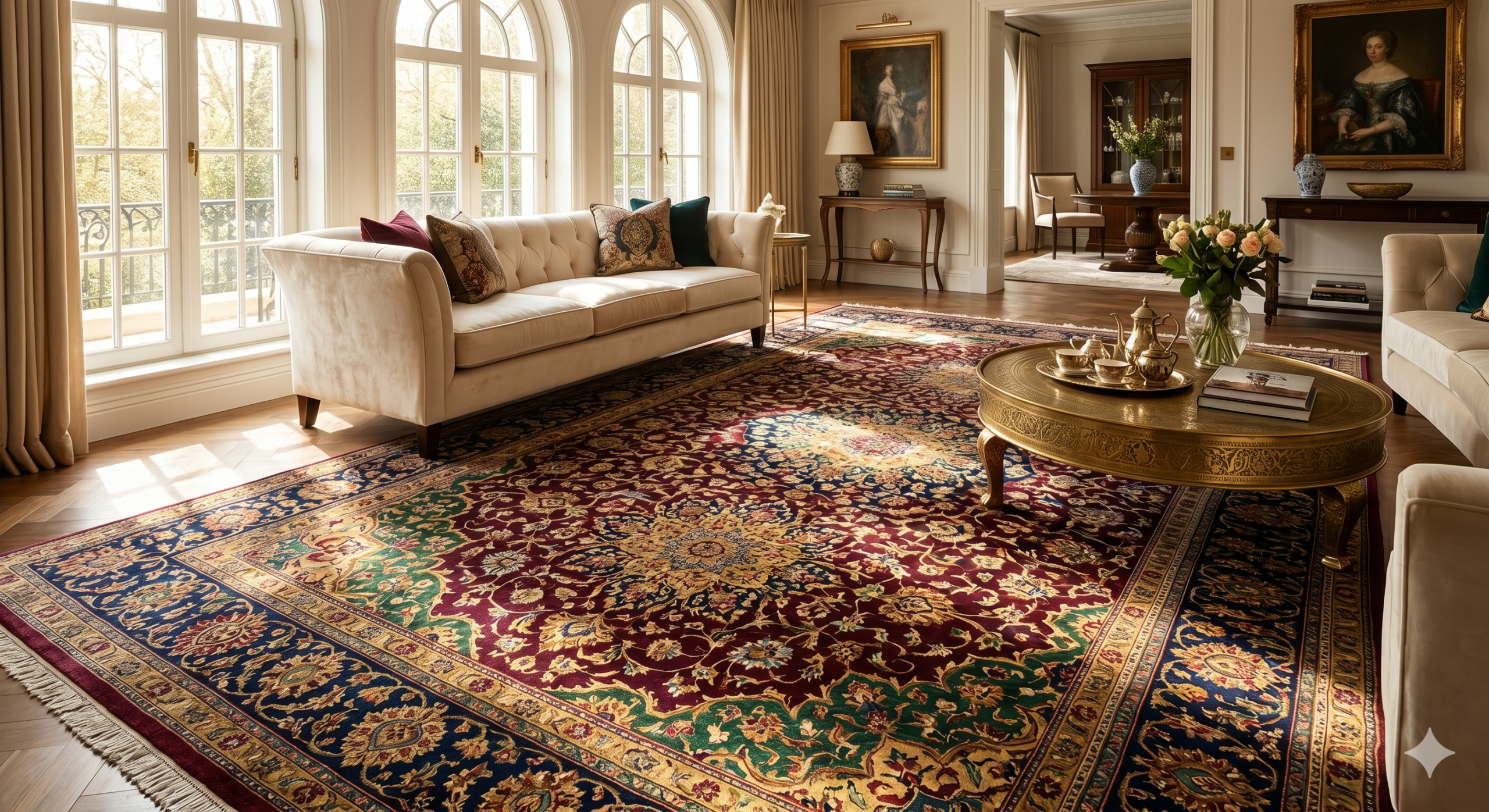
Hand Knotted Kashmiri Carpet – Ultimate Buyer’s Guide 2026
You have seen them online – those stunning carpets with rich colors and intricate floral patterns. The prices seem tempting. Then the carpet arrives, and it smells like chemicals. The weave is loose. The back is glued. You have been scammed.
Fake Kashmiri carpets flood the market every year, costing unsuspecting buyers thousands of dollars for machine-made imitations that fall apart in a few years.
This guide solves that problem. Written by the heritage team at Sonzal the Rainbow – a direct-source partner of master weavers in Srinagar, Kashmir – this post will teach you everything you need to know about finding a hand knotted Kashmiri carpet.
Table of Contents
Here is what you will learn:
- ✅ What a hand knotted Kashmiri carpet actually is and why it is valuable
- ✅ How to spot authentic hand-knotted silk and wool versus fake machine-made carpets
- ✅ Realistic pricing based on size, material, and knot density
- ✅ Where to buy safely online with certificates and proven authenticity
Quick Answer: A hand knotted Kashmiri carpet is a floor covering woven entirely by hand on a traditional vertical loom in the Kashmir Valley. Each knot is tied individually by skilled artisans, resulting in a durable, luxurious carpet with a knot density of at least 200 KPSI (knots per square inch). These carpets come with a Geographical Indication (GI) tag certifying their authentic Kashmiri origin.
Quick Reference – Hand Knotted Kashmiri Carpet at a Glance
| Aspect | Details |
|---|---|
| What is it? | Hand-knotted carpet woven in Kashmir Valley, India |
| Origin | Srinagar, Kashmir, India |
| Primary Material | Silk, Himalayan wool, or silk-wool blend |
| Price Range (USD) | $400 – $15,000+ |
| Durability | High (50–100+ years with proper care) |
| Care Difficulty | Moderate (professional cleaning recommended) |
| Best For | Living rooms, formal dining rooms, collector heirlooms, investment pieces |
| Authenticity Markers | GI tag, uneven reverse side, natural wool or silk smell, 200+ KPSI |
What Is a Hand Knotted Kashmiri Carpet?
A hand knotted Kashmiri carpet is a textile masterpiece woven entirely by hand on a traditional vertical loom. Unlike machine-made rugs that are produced in hours, each Kashmiri carpet is tied knot by knot by skilled artisans. A single 9×12 carpet can take anywhere from four to twelve months to complete, depending on the knot density and complexity of the design.
The craft arrived in Kashmir during the Mughal era in the 16th century. Emperor Akbar brought Persian master weavers to Kashmir to establish royal workshops. Over time, Kashmiri weavers developed their own distinctive style – combining Persian floral motifs with local influences. Today, Kashmir remains one of the few places in the world still producing true hand knotted silk and wool carpets.
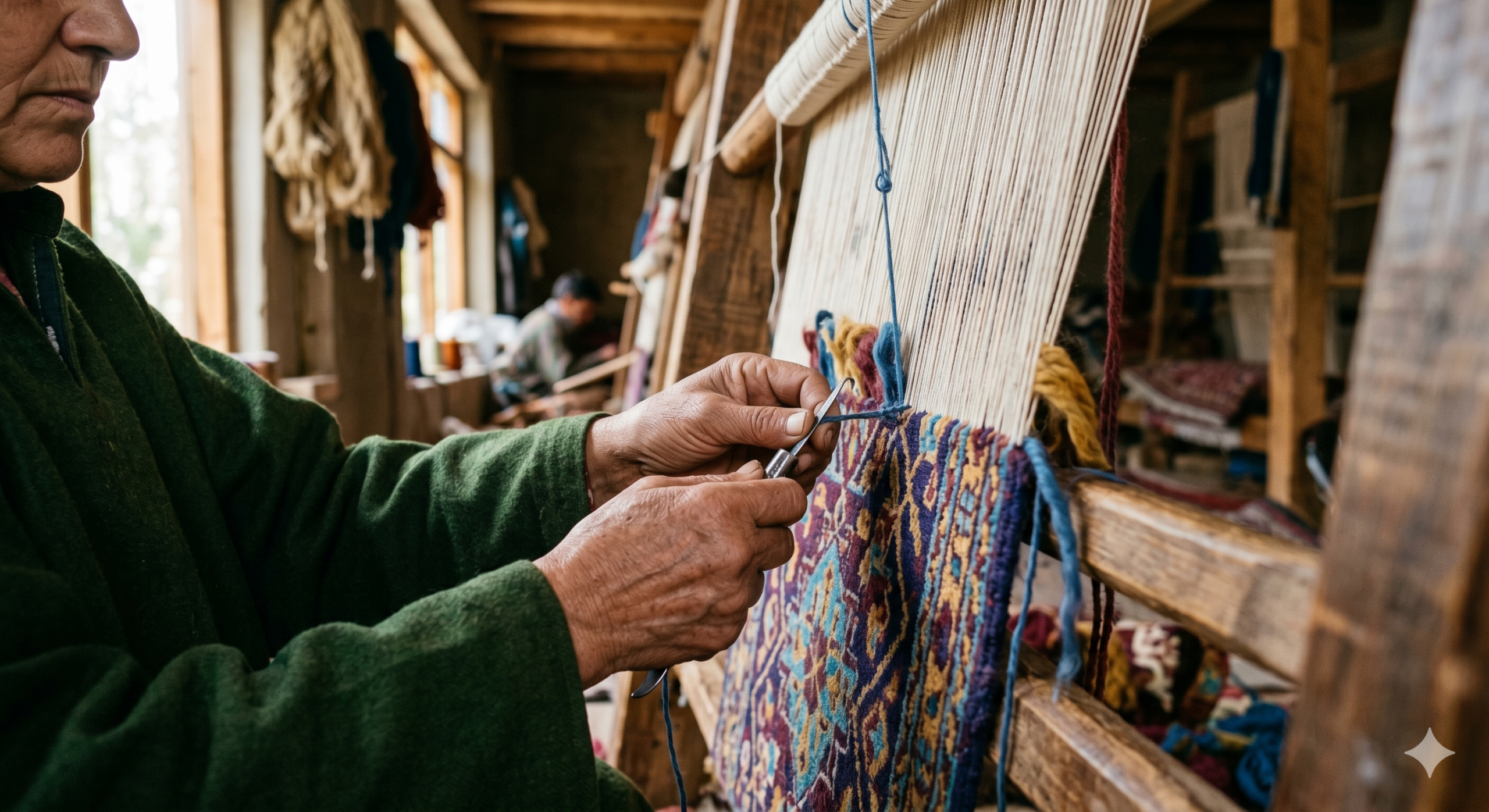
These carpets are valuable for several reasons:
- Material purity – They use 100 percent natural silk or Himalayan wool, never synthetic fibers
- Labor intensity – A high-quality carpet contains up to 2,000 knots per square inch
- Artisan skill – Weaving techniques are passed down through generations of families
- Cultural heritage – Authentic carpets carry a GI tag from the Government of India
Hand Knotted vs Machine Made – Side by Side
| Feature | Hand Knotted Kashmiri Carpet | Machine Made / Fake |
|---|---|---|
| Material | 100 percent natural silk or wool | Polyester, acrylic, or synthetic blend |
| Knot Density (KPSI) | 200 to 400+ | Less than 80 (printed or tufted) |
| Price for 9×12 | $3,000 to $12,000+ | $200 to $800 |
| Lifespan | 50 to 100+ years | 2 to 5 years |
| Texture | Soft, even, and luxurious | Rough, uneven, or unnaturally shiny |
| Smell | Natural wool or silk with earthy scent | Chemical smell like plastic or glue |
| Reverse Side | Uneven knot patterns visible | Uniform, glued, or printed backing |
| Certificate | Yes – GI tag or Certificate of Authenticity | None or fake generic “handmade” tag |
Pro Tip: Always ask the seller to show you the reverse side of the carpet. A genuine hand knotted Kashmiri carpet has an uneven, slightly bumpy back with visible knot patterns. A machine-made carpet has a perfectly flat, glued surface.

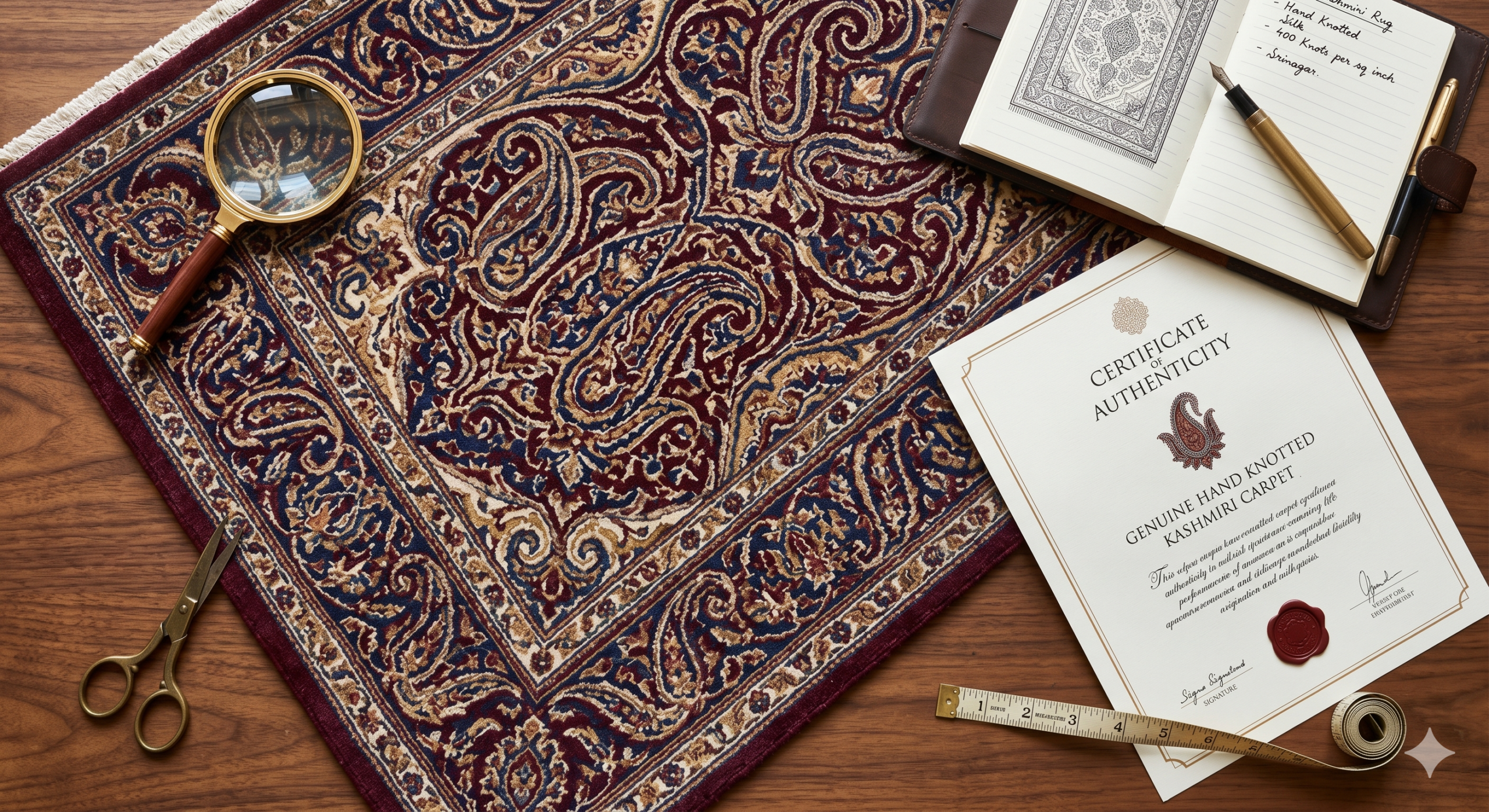
How to Verify Authenticity – Printable Checklist
| Step | Action Item | Done (✅) |
|---|---|---|
| 1 | Check for GI tag or certificate of authenticity | ☐ |
| 2 | Perform bend test – the carpet should be flexible, not stiff | ☐ |
| 3 | Examine the reverse side for irregular knot patterns | ☐ |
| 4 | Sniff for natural wool or silk smell – no chemical odor | ☐ |
| 5 | Ask for KPSI – minimum 200 knots per square inch | ☐ |
| 6 | Request direct sourcing proof – weaver village, date, and name | ☐ |
Price by Size, Material and Quality
| Size | Material | Quality Level | Knot Density (KPSI) | Average Price (USD) |
|---|---|---|---|---|
| 4×6 feet | Wool | Entry level | 100-150 | $400 – $800 |
| 6×9 feet | Wool | Good quality | 150-200 | $1,200 – $2,500 |
| 8×10 feet | Silk-wool blend | Premium | 200-300 | $2,500 – $5,000 |
| 9×12 feet | Pure silk | Premium plus | 300-400 | $5,000 – $12,000 |
| Custom size | Pure silk | Investment grade | 400+ | $15,000 – $30,000+ |
Pro Tip: A genuine 9×12 hand knotted Kashmiri silk carpet with 400 KPSI cannot cost $1,000. If the price seems too good to be true, it is fake. The labor alone – eight to twelve months of two artisans’ work – makes low prices impossible.
Expert Insights
| Element | Content |
|---|---|
| Persona Quote | “According to Mohammad Yousuf Ganai, a third-generation master weaver from Srinagar with thirty-five years of experience, ‘A single 9×12 silk carpet with 400 KPSI takes two artisans working full-time for eight to ten months to complete. No machine can replicate the soul of hand knots. Each carpet tells a story of patience, skill, and heritage.'” |
| Specific Fact | A 9×12 hand knotted Kashmiri silk carpet contains approximately 4.5 million individually tied knots. That is more than fifteen thousand knots per day for ten months. |
| Brand Statement | At Sonzal the Rainbow, we only source hand knotted carpets with a minimum of 200 KPSI, directly from GI-certified artisan cooperatives in Srinagar. We publish the weaver’s name, village, and weaving date for every carpet over $3,000. |
| External Citation | According to the Victoria & Albert Museum’s textile collection notes, Kashmiri carpet weaving reached its artistic peak under Mughal Emperor Akbar in the 16th century, when he brought Persian master weavers to Kashmir to establish royal workshops. |
How to Identify a Hand Knotted Kashmiri Carpet
Step 1: Start with the Certificate
Any seller offering a hand knotted Kashmiri carpet should provide a GI tag or a detailed Certificate of Authenticity. This document must include the material composition, knot density (KPSI), weaving location, and the weaver’s name or cooperative name.
Step 2: Examine the Reverse Side
Turn the carpet over. A genuine hand knotted carpet has an uneven, organic-looking back with visible knot bumps. Machine-made or tufted carpets have a perfectly flat, uniform back that is often glued or covered with a fabric mesh.
Step 3: Perform the Bend Test
Fold a corner of the carpet. A real hand knotted carpet is flexible and soft. A machine-made or low-quality glued carpet feels stiff and may crackle when you bend it.
Step 4: Smell the Carpet
Natural wool and silk have a subtle, earthy scent similar to clean wool clothing. Synthetic carpets and those made with cheap adhesives give off a strong chemical or plastic smell, especially when they are new.
Step 5: Ask for KPSI
Knots per square inch (KPSI) is the most important quality metric. Entry-level carpets have 100 to 150 KPSI. Good quality carpets have 200 to 250 KPSI. Premium carpets have 300 to 400 or more KPSI.
Step 6: Request Provenance Documentation
Reputable sellers can tell you which village in Kashmir the carpet came from, the approximate weaving date, and the weaver’s cooperative name. If a seller says “Asian rug” or simply “imported,” walk away.
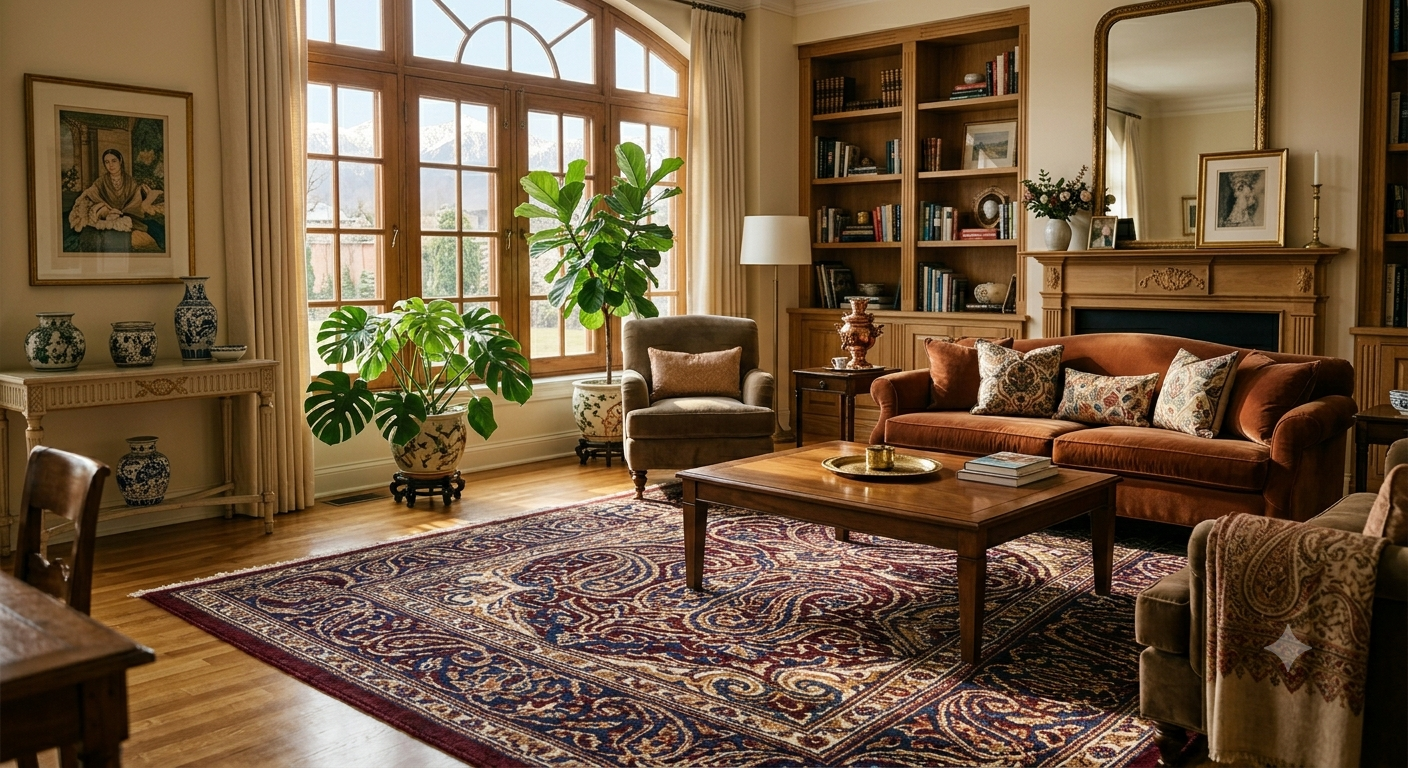
Red Flags to Avoid
| Red Flag | Why It Is a Problem |
|---|---|
| Price under $500 for a 9×12 carpet | This is impossible. Even wholesale direct from Kashmir is $2,000 or more. Such a low price means the carpet is synthetic or machine-made. |
| No photos of the reverse side | This hides machine backing, glue, or a printed design. Honest sellers always show both sides. |
| Vague origin like “Asian rug” or “Oriental carpet” | This avoids specific Kashmir provenance. Genuine sellers proudly say “Kashmir Valley, India.” |
| No return policy | This suggests the seller knows the product will not pass inspection. Reputable sellers offer a seven to fourteen day return policy. |
| No physical address or phone number | This makes it difficult to verify legitimacy or claim a return. Always verify seller contact details. |
| “100 percent handmade” but no KPSI number | This often means the carpet is tufted or power-loomed, not hand knotted. Hand knotted sellers always know the KPSI. |
Why Buy from Sonzal the Rainbow
| Benefit | What You Get |
|---|---|
| 🛡️ Certificate of Authenticity | Every hand knotted carpet comes with a verified GI tag or detailed Certificate of Authenticity that includes the weaver’s name, village, and knot density. |
| 🤝 Direct Artisan Sourcing | No middlemen. We work directly with GI-certified cooperatives in Srinagar, ensuring fair wages for weavers and authentic quality for you. |
| 🌍 Worldwide Shipping with Insurance | Fully tracked, insured door-to-door delivery. Free shipping on orders over $2,000. Delivery to the US, UK, UAE, EU, and Canada takes five to ten business days. |
| 🎨 Free Expert Consultation | A thirty-minute video call with our carpet experts to help you choose the right size, color, and design for your specific space. |
| 💯 Satisfaction Guarantee | A seven-day in-home inspection period. If you are not delighted, return the carpet for a full refund. |
| 🔄 Easy Returns | A fourteen-day return policy on non-custom carpets. We inspect and refund within five business days of receiving the returned carpet. |
“I was nervous buying a five thousand dollar carpet online, but Sonzal sent me videos of the actual carpet, the certificate, and even a photo of the weaver. It arrived in Dubai in five days. The quality is stunning – you can see every knot. I have already ordered a second one.”
— Fatima A., Dubai (verified buyer, purchased 9×12 pure silk hand knotted carpet, August 2026)
Frequently Asked Questions
| # | Question | Answer |
|---|---|---|
| 1 | What is a hand knotted Kashmiri carpet exactly? | A hand knotted Kashmiri carpet is a floor covering woven entirely by hand on a traditional loom in the Kashmir Valley using natural silk or wool. Unlike machine-made rugs, each carpet takes months to weave and comes with a GI tag or certificate of authenticity. Browse our Kashmiri carpet collection to see examples. |
| 2 | How can I tell if a carpet is hand knotted? | Check for four things. First, the reverse side should be uneven with visible knot patterns. Second, the carpet should smell like natural wool or silk, not chemicals. Third, the knot density should be at least 200 KPSI. Fourth, there should be a GI tag or certificate of authenticity. |
| 3 | How much does a hand knotted Kashmiri carpet cost? | Prices range from $400 for a small wool carpet measuring 4×6 feet to $12,000 or more for a large pure silk carpet measuring 9×12 feet. Custom high-density silk carpets with over 400 KPSI can cost $15,000 to $30,000 or more. |
| 4 | Where is the best place to buy a hand knotted Kashmiri carpet online? | Look for sellers who provide GI tags or certificates, KPSI numbers, photos of the reverse side, direct artisan provenance, and a clear return policy. Sonzal the Rainbow offers all of these plus a seven-day inspection period and live video verification before shipping. |
| 5 | How do I clean and maintain a hand knotted Kashmiri carpet? | Vacuum gently using a suction-only attachment – never use a rotating brush as it damages the knots. Blot spills immediately with a dry cloth and never rub. Professionally clean the carpet every three to five years using a specialist who understands hand knotted carpets. Avoid direct sunlight to prevent fading. Do not use steam cleaners or harsh chemicals. |
| 6 | Do you ship hand knotted Kashmiri carpets internationally? | Yes. We ship worldwide with full insurance and tracking. Delivery to the United States, United Kingdom, United Arab Emirates, European Union, Canada, Australia, and GCC countries typically takes five to ten business days. Shipping is free on orders over $2,000. |
| 7 | Can I get a custom size or design hand knotted carpet? | Absolutely. We work directly with master weavers in Srinagar to create custom sizes, colors, and patterns. The minimum order is $8,000, and lead time is six to twelve months depending on the knot density and complexity. Contact us to start the conversation. |
| 8 | What is your return policy on hand knotted carpets? | You have fourteen days from delivery to request a return for non-custom carpets. Carpets must be unused and in original condition. The buyer pays return shipping, and we refund the full product price within five business days of inspection. Custom orders are non-returnable but come with a video approval process before weaving begins. |
Buying a hand knotted Kashmiri carpet is not like buying a mass-produced rug from a department store. It is an investment in centuries of artistry, natural materials, and human skill – a piece that can be passed down for generations.
Three key takeaways:
- ✅ Authenticity is verifiable. Always demand a GI tag or certificate of authenticity, a KPSI number, and photos of the reverse side. Avoid carpets with chemical smells or glued backs.
- ✅ Price reflects quality. A real 9×12 pure silk hand knotted carpet with over 300 KPSI cannot cost $1,000. If the price seems too cheap, it is fake. The labor alone makes low prices impossible.
- ✅ Buy from trusted sources. Sonzal the Rainbow provides certificates, direct artisan provenance, a seven-day inspection period, and international shipping with insurance.
Each genuine hand knotted Kashmiri carpet is one of a kind. Once a carpet is sold, there will never be another exactly like it – the combination of colors, design, knot density, and natural dye lot variations makes every piece unique. If you find one you love, do not wait.
Ready to Find Your Perfect Hand Knotted Kashmiri Carpet?
Oman Contact: +96891179269 | +96876450569
India Contact: +919811449221 | +919718122866
