
Introduction
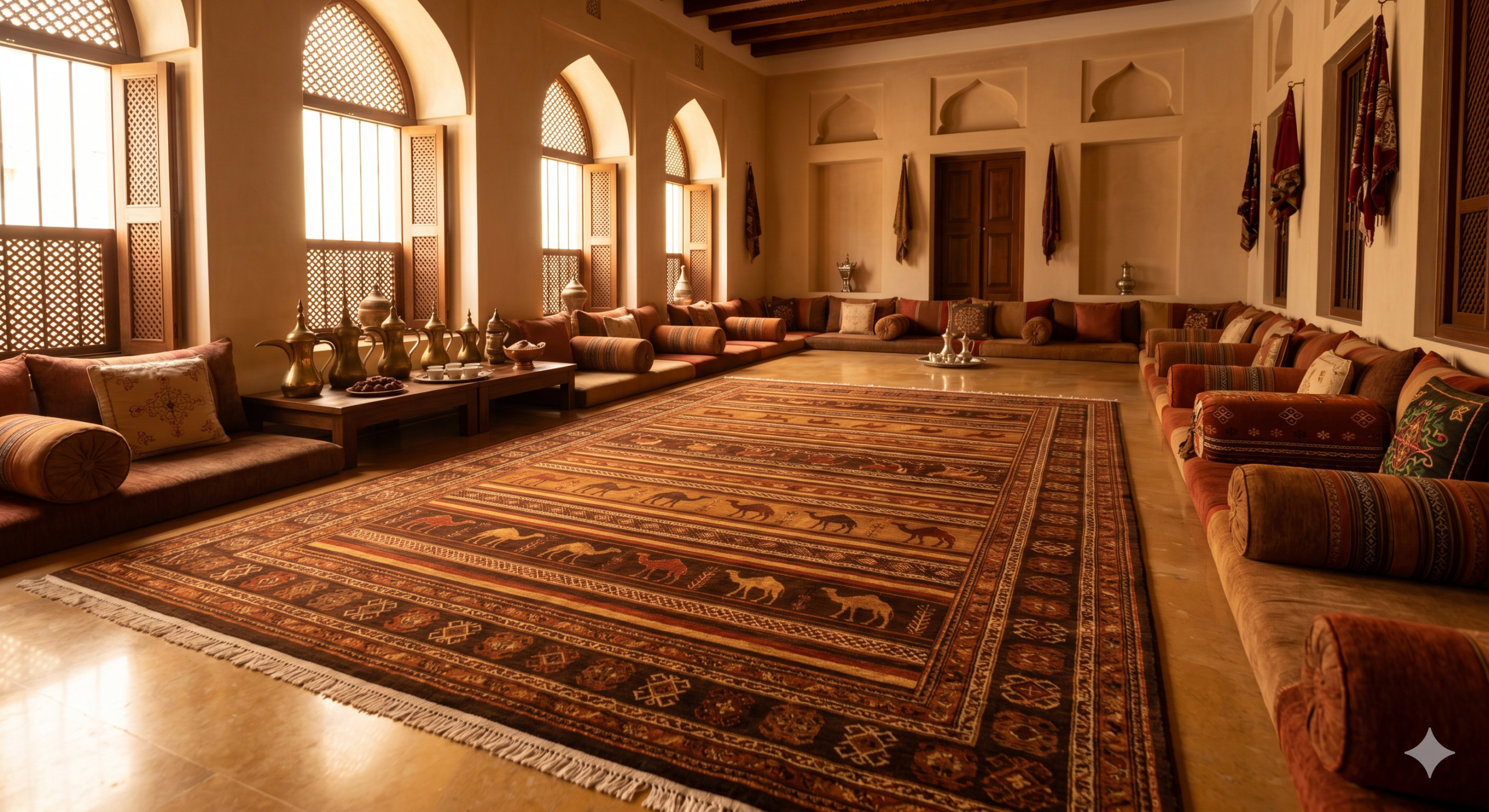
You have seen them in luxury homes and palaces across the Gulf – those stunning hand knotted Omani carpets with their distinctive geometric patterns and earthy, natural colors. But when you start looking to buy one, the prices vary wildly. How do you know what is authentic and what is a machine-made imitation?
The Omani carpet market is rich with heritage, but it is also filled with imported machine-made rugs passed off as local craftsmanship. Unscrupulous sellers prey on buyers who do not know the difference between authentic Sadu weaving and factory-made copies.
This guide solves that problem. Written by the heritage team at Sonzal the Rainbow – a trusted source for authentic Omani and Kashmiri handicrafts – this post will teach you everything you need to know about finding a genuine hand knotted Omani carpet.
Table of Contents
Here is what you will learn:
- ✅ What a hand knotted Omani carpet actually is and why it is culturally significant
- ✅ How to spot authentic Sadu weaving versus machine-made imitations
- ✅ Realistic pricing based on size, material, and craftsmanship
- ✅ Where to buy safely with certificates of authenticity
Quick Answer: A hand knotted Omani carpet is a traditional woven textile made by Bedouin artisans using a ground loom, typically crafted from sheep’s wool, goat hair, or camel hair. These carpets feature distinctive geometric patterns and stripes that reflect the desert environment, and they are often associated with the UNESCO-recognized Al Sadu weaving tradition.
Quick Reference – Hand Knotted Omani Carpet at a Glance
| Aspect | Details |
|---|---|
| What is it? | Hand-knotted carpet woven by Bedouin artisans using traditional Sadu techniques |
| Origin | Sultanate of Oman, primarily woven by Bedouin communities |
| Primary Material | Sheep wool, camel hair, goat hair, sometimes cotton |
| Price Range (USD) | $80 – $2,500+ (depending on size, material, craftsmanship) |
| Durability | High (30–50+ years with proper care) |
| Care Difficulty | Moderate (professional cleaning recommended) |
| Best For | Majlis, living rooms, formal spaces, collectors, cultural heritage pieces |
| Authenticity Markers | Hand-spun wool, natural plant dyes, geometric patterns, visible knot irregularities |
What Is a Hand Knotted Omani Carpet?
A hand knotted Omani carpet is a traditional woven textile crafted by Bedouin artisans in the Sultanate of Oman. The craft is deeply rooted in the region’s nomadic heritage, with weaving skills passed down through generations of Bedouin women.
The traditional Omani weaving technique is known as Al Sadu, which refers to a woven textile made by Bedouin women using a ground loom. The word “Al Sadu” means to lay threads horizontally in the loom, and the craft has been recognized by UNESCO as an Intangible Cultural Heritage of Humanity.
Omani carpets are woven using natural fibers found in the local environment – sheep’s wool, camel hair, and goat hair are the primary materials. These fibers are often left in their natural colors or dyed using plant-based dyes extracted from roots, stems, and husks of various plants. The resulting carpets are tightly woven, durable textiles designed to withstand harsh desert conditions.
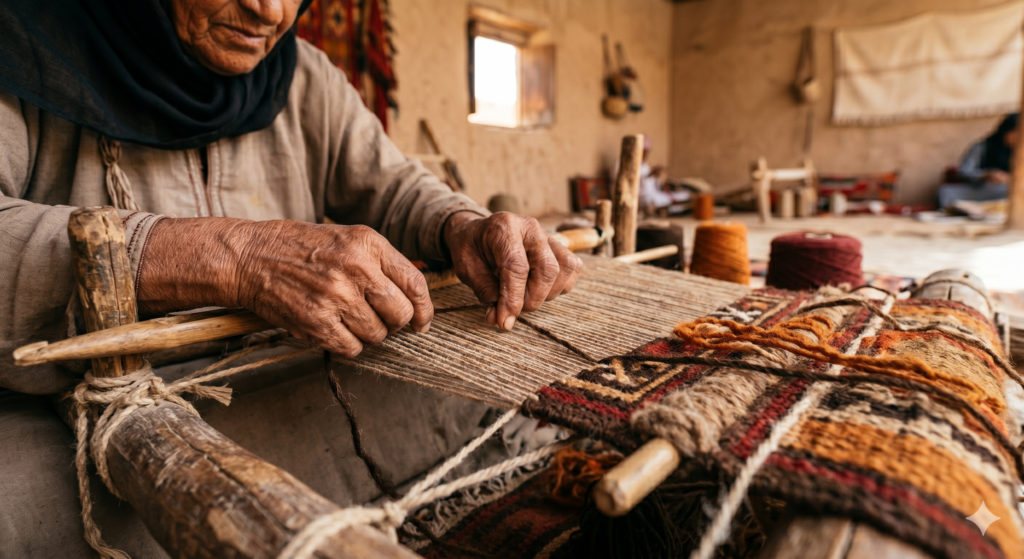
The designs of Omani carpets are typically simple but meaningful. They feature geometric patterns, stripes, dots, and lines that reflect the desert environment in their simple, pure form. These designs are not merely decorative – they carry deep cultural and metaphysical symbolism, with each pattern representing ancient beliefs, femininity, beauty, and the Bedouin way of life.
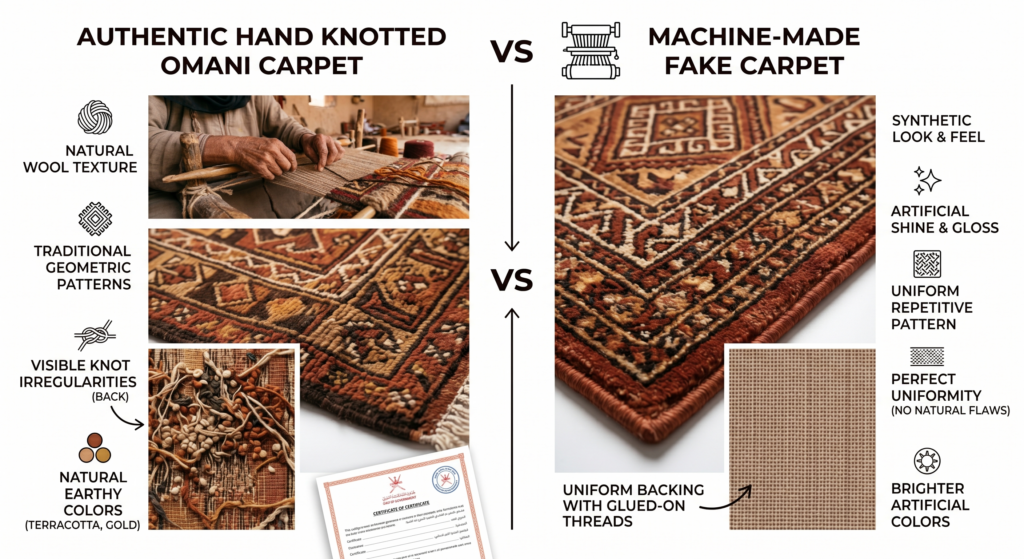
Hand Knotted Omani Carpet vs Machine-Made – Side by Side
| Feature | Authentic Hand Knotted Omani Carpet | Machine-Made / Fake |
|---|---|---|
| Material | 100% natural wool, camel hair, or goat hair | Synthetic fibers, polyester, or blended materials |
| Weaving Method | Hand-knotted on ground loom | Power-loomed or printed |
| Design | Geometric patterns, stripes, natural irregularities | Perfectly uniform, often printed designs |
| Dyes | Natural plant-based dyes | Chemical synthetic dyes |
| Price | $200 – $2,500+ | $50 – $200 |
| Lifespan | 30 – 50+ years | 2 – 5 years |
| Texture | Soft, natural, slightly irregular | Uniform, often stiff or overly shiny |
| Certificate | Yes – certificate of authenticity available | None or fake generic tags |
Pro Tip: A genuine hand knotted Omani carpet will have small imperfections in the design and weaving. These are not flaws – they are the signature of handcraftsmanship. Machine-made carpets will have perfect, uniform patterns.
How to Verify Authenticity – Printable Checklist
| Step | Action Item | Done (✅) |
|---|---|---|
| 1 | Check for certificate of authenticity (شهادة الأصالة) | ☐ |
| 2 | Examine the weave – look for slight irregularities (sign of handcraft) | ☐ |
| 3 | Feel the texture – natural wool should feel soft, not synthetic or stiff | ☐ |
| 4 | Look for natural color variations – plant dyes create subtle variations | ☐ |
| 5 | Ask about the material – should be sheep wool, camel hair, or goat hair | ☐ |
| 6 | Check the price – if it seems too cheap, it is likely machine-made | ☐ |
| 7 | Request provenance – where and by whom was the carpet woven | ☐ |
| 8 | Examine the knots – more knots per square inch means higher quality | ☐ |
Price Guide – What Different Price Points Buy You
Pro Tip: In Oman, a 1.5m x 2.5m rug of sheep wool typically costs around RO 30 (approximately $80). Bargaining is expected, and you will disappoint the seller if you do not even try.
Expert Insights
| Element | Content |
|---|---|
| Persona Quote | “According to Zainab Al Zadjali, a researcher who has studied the metaphysical symbolism of Omani rug designs, ‘The Bedouin rug in Oman contains groups of dots, lines, abstract geometrical figures and various colours, each of which are rich in symbolism and suggestion. These symbols are inherited and have taken root through many generations.'” |
| Specific Fact | Traditional Al Sadu weaving was inscribed on UNESCO’s Representative List of the Intangible Cultural Heritage of Humanity in 2025, recognizing the skill and cultural significance of Bedouin women weavers. |
| Brand Statement | At Sonzal the Rainbow, we source hand knotted Omani carpets directly from traditional Bedouin weavers. Every carpet comes with a certificate of authenticity and detailed provenance information. |
| External Citation | According to UNESCO’s Intangible Cultural Heritage listing, Al Sadu weaving reflects the desert environment in its simple, pure form, featuring geometric designs combined to flow in rhythmic repetition and symmetry. |
How to Identify and Buy an Authentic Hand Knotted Omani Carpet
Step 1: Understand the Materials
Authentic Omani carpets are made from natural fibers found in the local environment – sheep’s wool, camel hair, and goat hair. These fibers are often used in their natural state or colored with plant dyes derived from cactus, pomegranates, onions, and other plants. If a carpet feels synthetic or has a chemical smell, it is not authentic.
Step 2: Examine the Weave
Genuine hand knotted Omani carpets will have small irregularities in the design and weaving. These are the marks of handcraftsmanship. Machine-made carpets will have perfectly uniform patterns and edges.
Step 3: Check for Natural Dyes
Natural plant-based dyes create subtle color variations – no two sections will look exactly alike. Synthetic dyes produce perfectly uniform, often overly bright colors that do not fade naturally over time.
Step 4: Look for the Geometric Patterns
Traditional Omani carpets feature simple geometric designs, stripes, dots, and lines that reflect the desert environment. These designs carry deep cultural symbolism and are a hallmark of authentic Bedouin weaving.
Step 5: Ask About the Origin
A reputable seller can tell you where and by whom the carpet was woven. If the seller cannot provide this information, be cautious. You can find authentic local carpets at the Omani National Heritage Gallery in Shati Al Qurm, or buy them directly from weavers on the road to Jabel Shams.
Step 6: Request a Certificate of Authenticity
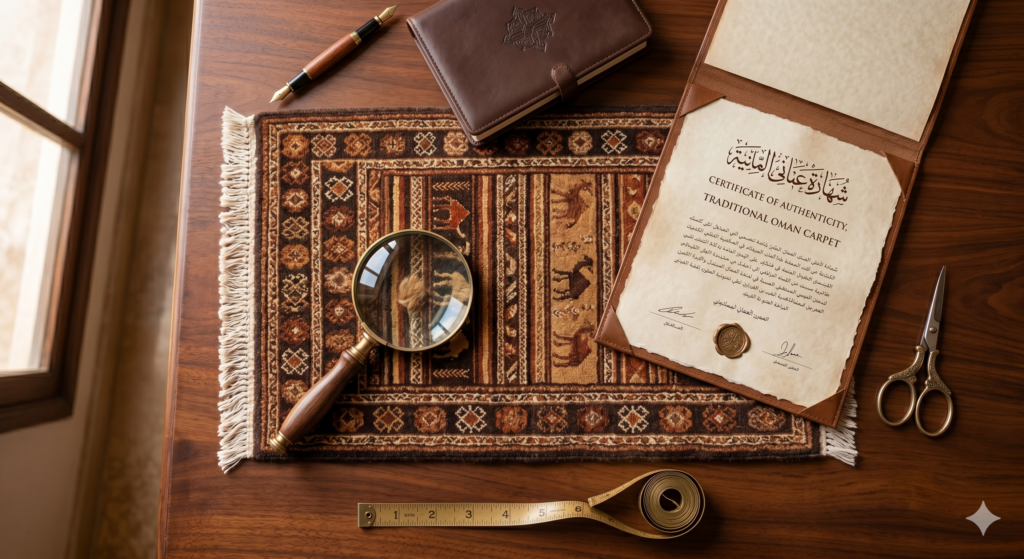
Authentic carpets should come with a certificate of authenticity (شهادة الأصالة). This document should describe the materials, age, and origin of the carpet.
Red Flags to Avoid
| Red Flag | Why It Is a Problem |
|---|---|
| Perfectly uniform pattern | Indicates machine-made or printed carpet, not hand-knotted |
| Chemical smell | Suggests synthetic materials or artificial dyes |
| Price under $50 for a medium rug | Even a basic wool rug costs more when hand-knotted |
| No certificate of authenticity | Reputable sellers provide documentation |
| Vague origin (“imported” or “Asian”) | Avoids specific Omani provenance |
| Synthetic-feeling texture | Natural wool and camel hair feel soft and warm |
Why Buy from Sonzal the Rainbow
| Benefit | What You Get |
|---|---|
| 🛡️ Certificate of Authenticity | Every Omani carpet comes with a verified certificate of authenticity detailing materials and origin. |
| 🤝 Direct Artisan Sourcing | No middlemen – we work directly with traditional Bedouin weavers in Oman. |
| 🌍 Worldwide Shipping with Insurance | Fully tracked, insured door-to-door delivery. Free shipping on orders over $1,000. |
| 🎨 Free Expert Consultation | A video call with our carpet experts to help you choose the right size and design for your space. |
| 💯 Satisfaction Guarantee | A 7-day in-home inspection period. If you are not delighted, return the carpet for a full refund. |
| 🔄 Easy Returns | A 14-day return policy on non-custom carpets. We inspect and refund within 5 business days. |
“I was looking for an authentic hand knotted Omani carpet for my majlis and found Sonzal the Rainbow. They sent me the certificate of authenticity, photos of the weaver, and even a video of the weaving process. The carpet arrived in perfect condition and looks stunning in my home.”
— Ahmed S., Muscat (verified buyer, purchased 3x4m Omani wool carpet, May 2026)
Frequently Asked Questions
| # | Question | Answer |
|---|---|---|
| 1 | What is a hand knotted Omani carpet exactly? | A hand knotted Omani carpet is a traditional woven textile made by Bedouin artisans in Oman using natural fibers like sheep wool, camel hair, or goat hair. It features geometric patterns and stripes and is associated with the UNESCO-recognized Al Sadu weaving tradition. Browse our Omani carpet collection to see examples. |
| 2 | How can I tell if an Omani carpet is authentic? | Check for natural wool or camel hair texture, slight irregularities in the weave (sign of handcraft), natural color variations from plant dyes, geometric patterns, and a certificate of authenticity. Avoid carpets with uniform patterns, chemical smells, or synthetic textures. |
| 3 | How much does a hand knotted Omani carpet cost? | Prices range from $80 for a small runner to $2,500 or more for a large premium camel hair carpet. A 1.5m x 2.5m sheep wool rug typically costs around $80 in Oman. The more knots per square inch, the higher the quality and price. |
| 4 | Where is the best place to buy Omani carpets? | You can find authentic local carpets at the Omani National Heritage Gallery in Shati Al Qurm, or buy them directly from weavers on the road to Jabel Shams. Online, look for sellers who provide certificates of authenticity and detailed provenance. Sonzal the Rainbow offers verified authentic Omani carpets with full documentation. |
| 5 | How do I clean and maintain an Omani carpet? | Vacuum gently using a suction-only attachment. Blot spills immediately with a dry cloth. Professionally clean every 3-5 years. Avoid direct sunlight to prevent fading. Do not use steam cleaners or harsh chemicals. |
| 6 | Do you ship Omani carpets internationally? | Yes. We ship worldwide with full insurance and tracking. Delivery to the GCC, US, UK, EU, Canada, and Australia takes 5-10 business days. Free shipping on orders over $1,000. |
| 7 | Can I get a custom size or design Omani carpet? | Yes. We work with traditional Bedouin weavers to create custom sizes, colors, and patterns. Lead time is 3-6 months depending on complexity. Contact us to start the conversation. |
| 8 | What is the Al Sadu weaving tradition? | Al Sadu is a traditional weaving technique practiced by Bedouin women in Oman and other Gulf countries. It was inscribed on UNESCO’s Intangible Cultural Heritage list in 2025. The technique uses a ground loom and natural fibers to create tightly woven, durable textiles with geometric patterns reflecting the desert environment. |
Conclusion
Buying a hand knotted Omani carpet is not just about acquiring a floor covering – it is about owning a piece of living cultural heritage that has been passed down through generations of Bedouin women.
Three key takeaways:
- ✅ Authenticity is in the details. Look for natural materials (wool, camel hair, goat hair), slight irregularities in the weave, natural color variations from plant dyes, and geometric patterns. Avoid machine-made uniformity and synthetic materials.
- ✅ Price reflects craftsmanship. A genuine hand knotted Omani carpet cannot cost $50. The labor, materials, and cultural heritage make it worth more. If the price seems too good to be true, it is a fake.
- ✅ Buy from trusted sources. Sonzal the Rainbow provides certificates of authenticity, direct artisan sourcing, and a satisfaction guarantee. Your investment is protected.
Each genuine hand knotted Omani carpet is unique – the combination of natural fibers, plant dyes, and the weaver’s skill ensures that no two carpets are exactly alike. If you find one you love, do not wait.
Ready to Find Your Perfect Hand Knotted Omani Carpet?
Oman Contact: +96891179269 | +96876450569
India Contact: +919811449221 | +919718122866
