Crewel Embroidery Kashmir – The Ultimate Guide to Zalakdozi Craft | Sonzal the Rainbow
Crewel Embroidery Kashmir – The Ultimate Guide to Zalakdozi, the Art of Hook Embroidery
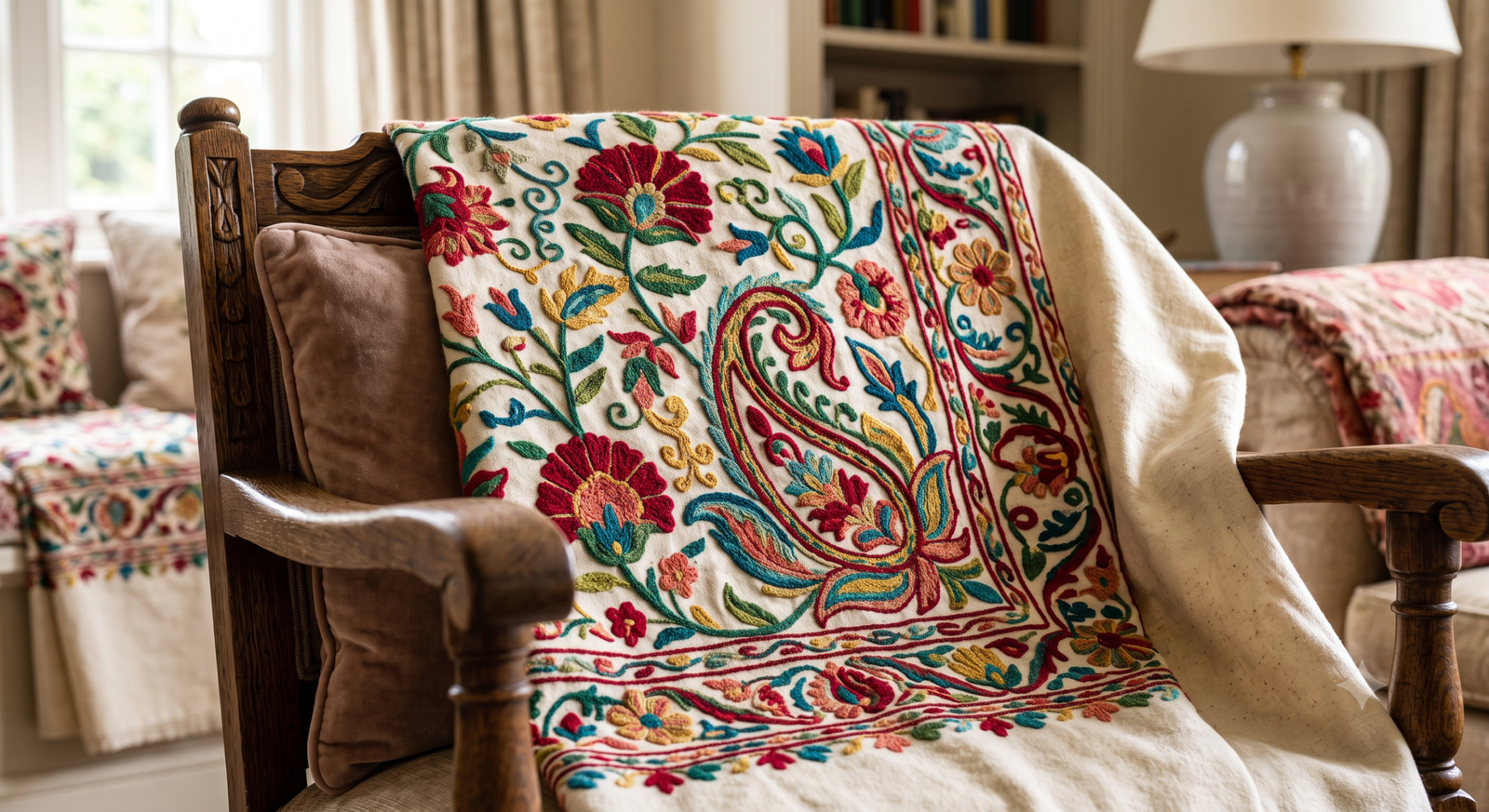
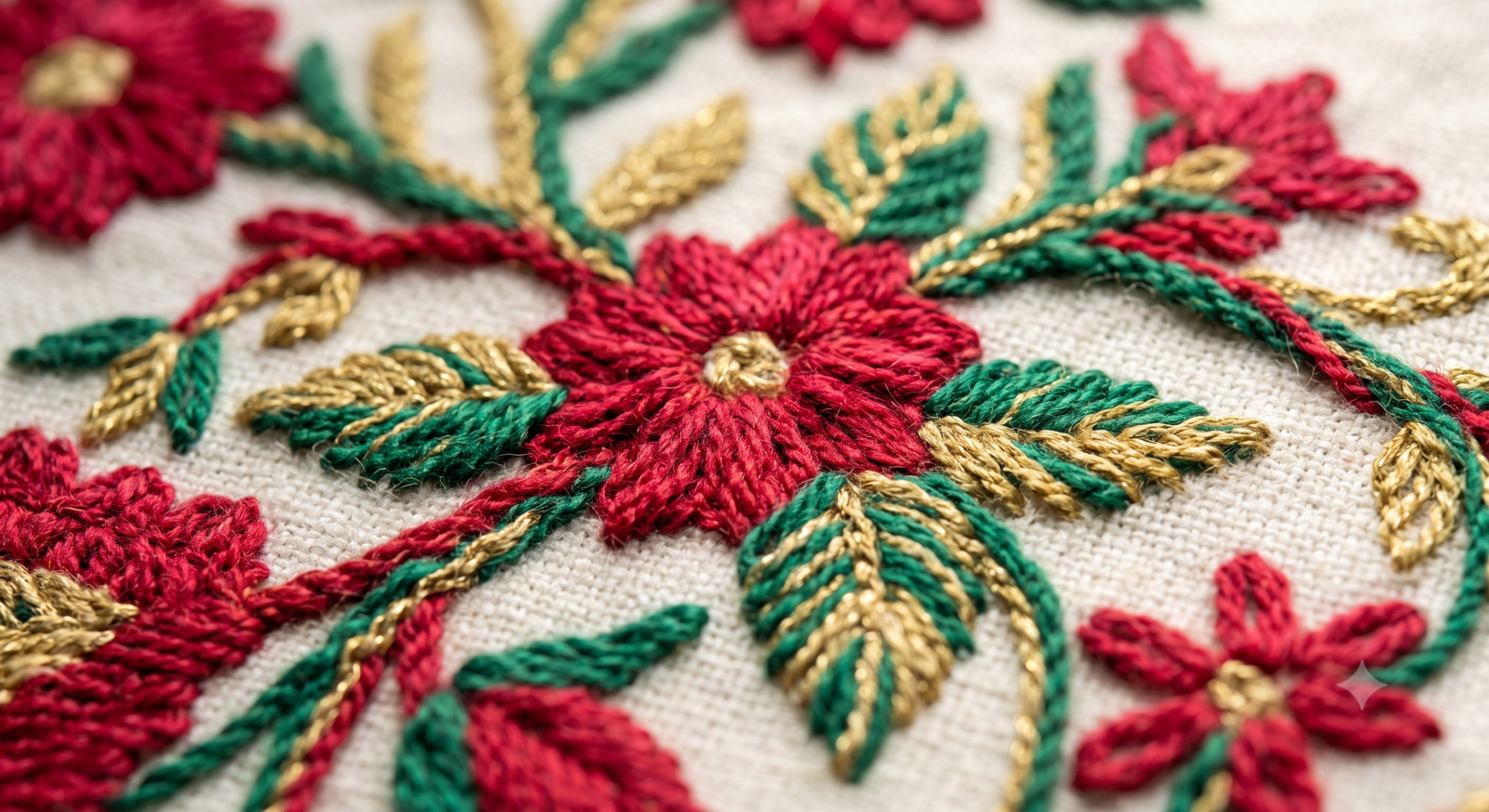
Imagine running your fingers across a fabric so richly textured that you can feel every stitch — each one placed by hand, each one telling a story of centuries-old tradition. The vibrant threads catch the light, revealing intricate floral patterns that seem to dance across the surface. This is the magic of crewel embroidery Kashmir has perfected over centuries.
Kashmiri embroidery, popularly known as Kashida, along with the Kashmiri carpet industry, is one of the biggest commercial crafts of India . Among its many forms, crewel embroidery — locally known as Zalakdozi — stands out as one of the most distinctive and beloved techniques. Using a hooked needle called an aari, artisans create elaborate floral and paisley patterns on fabric, typically wool or cotton, with designs inspired by the region’s natural beauty .
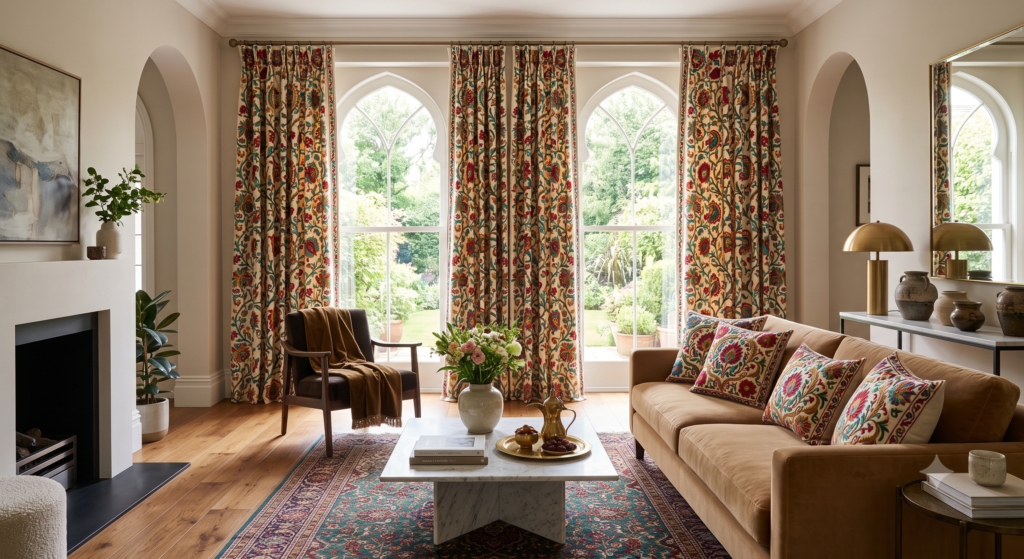
Though the embroidery originated in the form of shawl ornamentation, it is now used to decorate a range of articles including yardage, home furnishings, jackets, coats, mufflers, and jutis (leather footwear) . From curtains and upholstery to cushion covers and wall hangings, crewel embroidery has become synonymous with luxury home decor worldwide.
This guide will take you on a journey through the vibrant world of crewel embroidery Kashmir has to offer — exploring its rich history, intricate techniques, traditional motifs, pricing, and how to identify authentic pieces.
Table of Contents
✅ What crewel embroidery is and why it is one of Kashmir’s most valued crafts
✅ The fascinating history and cultural significance of Zalakdozi
✅ Traditional motifs and design elements that define Kashmiri crewel work
✅ The step-by-step process from design to finished product
✅ Pricing insights and applications in modern home decor
✅ How to identify authentic crewel embroidery and care for your pieces
Quick Reference – Crewel Embroidery Kashmir at a Glance
Aspect
Details
What is it?
Hand-embroidered fabric using a hooked needle (aari) with woolen yarn
Local Name
Zalakdozi (hook embroidery)
Origin
Kashmir Valley, introduced in the 15th century
Primary Materials
Woolen yarn (single or double-ply) on cotton, linen, velvet, or silk base
Key Technique
Chain stitch using a hooked needle (Ara Kunj)
Base Colors
Cream, white, or soft pastel shades
Common Motifs
Chinar leaf, paisley (badam), tree of life, floral bouquets, Shikargarh (hunting scenes)
Price Range
$18 – $120+ per meter (USD, depending on complexity and materials)
Crewel embroidery, locally known as Zalakdozi or Zalakdoz, is one of the specialized styles of embroidery practiced in Kashmir . The word “crewel” refers to the fine, worsted wool yarn used in the embroidery, which creates beautiful and detailed motifs on various fabric surfaces .
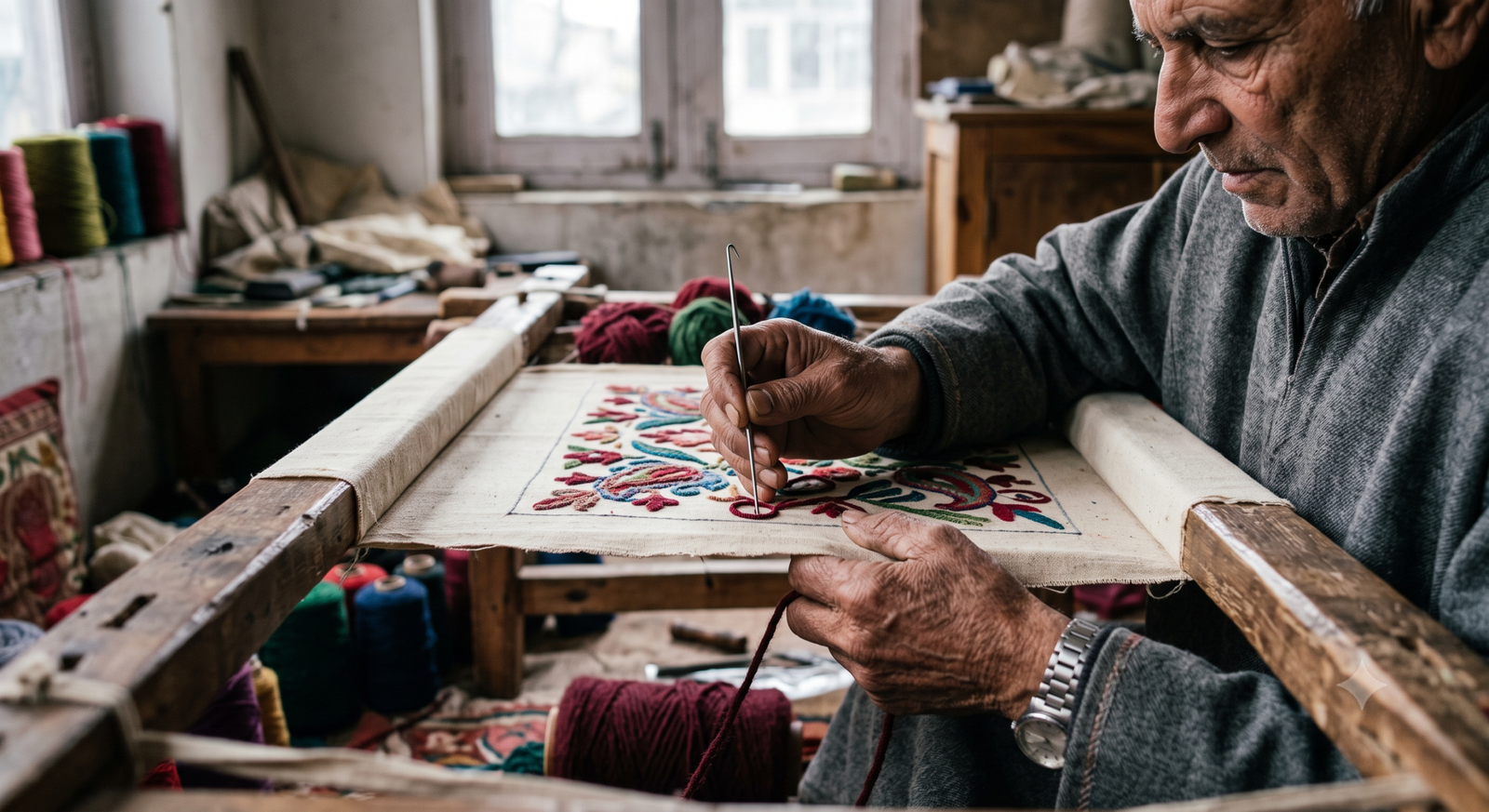
The embroidery is done with a hooked needle called an Ara Kunj or aari. The artisan inserts the hook from the right while the thread is held on the underside. The design shows itself in the form of small loops, appearing as a chain stitch on the surface . While maintaining the same quality, hook work covers a much larger area than needle work in the same amount of time .
The Difference Between Crewel and Sozni
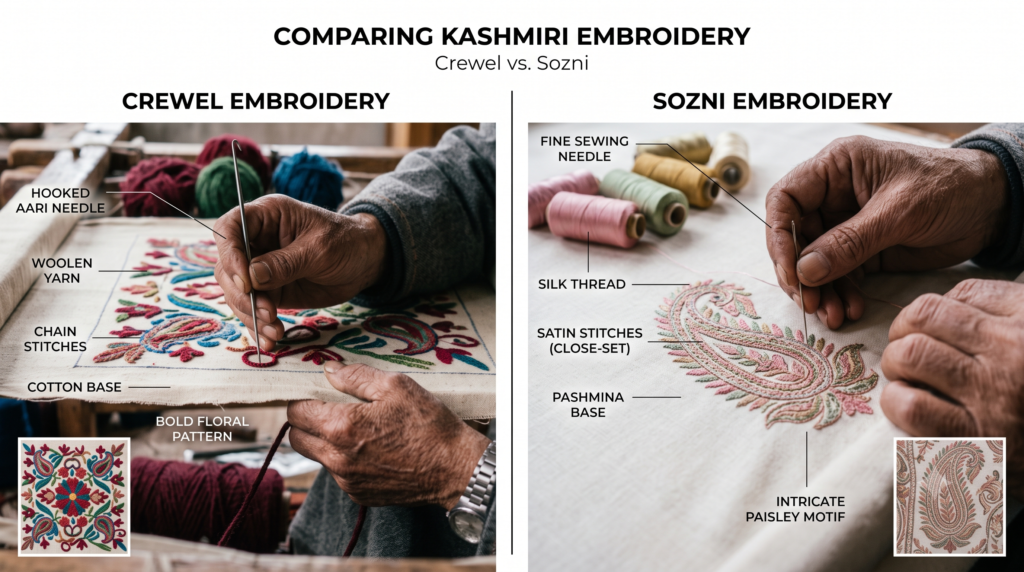
Crewel embroidery is distinct from Sozni embroidery, another renowned Kashmiri technique:
Feature
Crewel Embroidery (Zalakdozi)
Sozni Embroidery
Tool
Hooked needle (aari)
Fine needle
Stitch Type
Chain stitch
Satin stitch
Thread
Woolen yarn (single or double-ply)
Silk or fine cotton
Fabric
Cotton, linen, velvet, silk (thicker base)
Fine fabrics like pashmina
Speed
Covers larger area faster
Slower, more delicate
Application
Home furnishings, upholstery, curtains
Shawls, dress materials
Insider Tip: While wool and cotton remain popular choices for base fabric and embroidery, rayon and artificial silk threads have replaced natural silk threads in some applications. These synthetic threads are mass-produced in mills, providing a consistent supply for embroiderers .
One-Ply vs Two-Ply Crewel Embroidery
Crewel embroidery uses woolen yarn, and the quality depends on whether it is single-ply or double-ply :
Single-Ply Crewel – Uses a single woolen yarn. The lower yarn cost results in a cheaper fabric, allowing for a more extensive range when selling products to customers.
Two-Ply Crewel – Uses more durable double-ply woolen yarn. It is costlier and known to last for decades if properly taken care of. This yarn gives a more neat and uncluttered appearance .
The Rich History of Crewel Embroidery in Kashmir
Origins in the 15th Century
Crewel embroidery in Kashmir has a rich historical significance. Its roots can be traced back to the 15th century, when it was introduced by the ruler Zain-ul-Abidin, also known as Badshah. Under his patronage, the art form flourished and gained recognition as a distinguished craft in the region .
The Craftsmanship Heritage
All traditional embroidery in Kashmir was historically done by men. Being a hereditary craft, the son is apprenticed in his father’s workshop from the age of eight to ten years. It is believed within the community that it takes sixteen years to master the craft .
However, this tradition has evolved. Recent years have seen many women practicing the craft . One remarkable example is Zamruda Bano from Kulgam district in South Kashmir, a 60-year-old artisan who learned crewel embroidery in her childhood and has set up over 200 centers across Jammu and Kashmir, employing more than a thousand women . Her venture generates around Rs. 10-15 lakhs a month, with the larger part disbursed to employees .
Global Recognition
Crewel embroidery is now recognized worldwide. Creel embroidery’s products have even found their way to museums and top luxury hotels — including the world’s largest Kashmiri chain-stitch wall hanging at the iconic Taj Palace Hotel in India .
Traditional Motifs and Designs
The Design Language of Crewel Embroidery
The designs range from Persian to French, from Chinar leaf (an important tree in the Valley whose leaf has been amply used in embroidery) to Shikargarh (hunting scenes) .
Common traditional patterns include :
Chinar Leaf – The majestic Chinar tree found abundantly in Kashmir
Shikargarh – Hunting scenes with regal imagery
Theridar – Floral patterns
Bulbuldar – Bird and flower motifs
Guldar – Flower patterns
Badamadar – Almond-shaped buta designs believed to have been in use from the first quarter of the 18th century
Kalka – The most popular flame-shaped motif
Tree of Life – A standard motif in crewel design
Colors and Palette
The base color of the fabric is generally cream, white, or similar pastel shades. A wide range of colors are used by Kashmiri embroiderers for the embroidery yarns :
Crimson (Gulnar)
Scarlet (Kirmizi)
White (Sufed)
Green (Zingari)
Dark Green (Siah Sabaz)
Light Blue (Asmani)
Blue (Firozi)
Yellow (Zard / Sharbati)
Purple (Uda)
Black (Mushki)
Earlier, the yarns were dyed exclusively in vegetable dyestuff, but today synthetic dyes are increasingly used .
Insider Tip: The intrinsic worth of each piece lies in the sizes of the stitches and the yarn used. Tiny stitches are used to cover the entire area — the figures or motifs are worked in striking colours; the background in a single colour, made up of a series of coin-sized concentric circles which impart dynamism and a sense of movement to the design. Stitches ought to be small, even-sized, and neat. The background fabric should not be visible through the stitches .
The Crewel Making Process
The crewel making process is a meticulous journey from design to finished product .
Step 1: Design Creation
The designer creates a rough sketch on translucent paper. The pattern sheet is then punched with holes to create a template for printing .
Step 2: Printing/Tracing
The design is traced onto the fabric by professional tracers called Naquashband. They have perforated sheets with innumerable designs and lay these sheets on the fabric. Chalk or charcoal powder is rubbed over it, which leaves the impression of the design on the fabric’s surface. Gum Arabic or oil is added to the powder to make the tracing durable. The outlines are highlighted using a wooden pen (kalam) .
Alternatively, for larger bolts, an ink-soaked cloth is wiped over the design sheet, allowing ink to seep through the tiny pores to cast a clean imprint on the fabric underneath. The process is repeated to ensure design consistency .
Step 3: Embroidery
The printed fabric makes its journey to the craftsmen where the design slowly starts coming to life. Using the aari hook, artisans create chain stitches following the printed pattern .
Step 4: Washing
Once embroidered, the fabric is sent for washing to remove traces of dirt and stains accumulated during the embroidery work. The drying process can take up to a day, and once done, the fabric is steam-ironed to ensure a crease-free finish .
Pro Tip: A twenty-yard bolt with a “Tree of Life” design could take between eight to ten weeks to complete, excluding delays due to personal issues of the craftsmen .
Crewel Embroidery Pricing Guide
Understanding pricing for crewel embroidery is essential for buyers. Here is a breakdown of current market prices in USD (converted from INR using approximate exchange rate of 1 USD ≈ 83 INR):
Product Type
Material
Design Complexity
Price (USD/Meter)
Light Crewel Fabric
Cotton Dusooti
Light embroidery
$16 – $22
Standard Crewel Fabric
Cotton Duck
Medium floral
$22 – $30
Heavy Crewel Fabric
Cotton Duck
Dense embroidery
$35 – $45
Premium Crewel Fabric
Cotton Duck
Danz Dar / Heavy floral
$44 – $48
Silk Organza Crewel
Pure Silk Organza
Fine embroidery
$54 – $58
Custom Crewel Fabric
Cotton/Velvet
Custom design
$60+
Pro Tip: The most expensive crewel fabrics feature dense, multi-color embroidery with double-ply wool and intricate designs like Hibiscus or Danz Dar. A 20-meter bolt with complex designs can take eight to ten weeks to complete .
Pricing Comparison with Standard Online Rates
According to current market rates, crewel embroidery fabrics command premium pricing compared to other Indian embroideries:
Machine Embroidered Fabrics – $5 – $15 per meter (significantly cheaper but lacks the handmade value)
Standard Hand Embroidered Fabrics – $15 – $30 per meter
Kashmiri Crewel Fabric – $16 – $60+ per meter
The premium pricing reflects the handcraftsmanship, unique designs, and the fact that each piece is one of a kind.
Applications of Crewel Embroidery
Home Furnishings
Crewel embroidery is widely used for :
Curtains and drapes
Upholstery and sofa covers
Cushion covers and pillows
Bedspreads and duvets
Table covers and runners
Wall hangings
Apparel
The craft also adorns :
Kurtas, kurtis, and dresses
Jackets and coats
Mufflers and stoles
Footwear (jutis)
Evolution to Modern Tastes
While preserving its traditional essence, this art form has evolved to cater to modern tastes. Contemporary designs embrace a fusion of traditional and contemporary elements, enabling artists to explore new artistic possibilities and attract a broader audience .
How to Identify Authentic Kashmiri Crewel Embroidery
Step 1: Examine the Stitches
Authentic crewel embroidery features:
Chain stitches created with a hooked needle (aari)
Small, even-sized, neat stitches where the background fabric is not visible
Natural variations in stitch size and pattern — these are signs of handcraftsmanship
Step 2: Check the Materials
Thread: 100% wool (single or double-ply) or high-quality wool blends
Base Fabric: Cotton, cotton duck, linen, silk, or velvet
Dyes: Natural variations in color suggest natural dyes; perfectly uniform colors may indicate synthetic dyes
Step 3: Look for Irregularities
Hand-embroidered crewel fabrics will have slight variations — this is the hallmark of authentic craftsmanship. Machine-made fabrics are perfectly uniform.
Step 4: Ask for Provenance
Reputable sellers can tell you which region the crewel work came from and the materials used. Kashmiri crewel embroidery is indigenous to this region only .
Step 5: Know the Price
Authentic, high-quality Kashmiri crewel embroidery commands a premium price due to the handcraftsmanship involved. If the price seems too low, it may be machine-made or a lower-quality piece.
Caring for Your Crewel Embroidery
Crewel embroidery is a delicate art and needs to be properly cared for .
Do’s
Dry Clean Only for most crewel fabrics to avoid dye bleeding from embroidery yarns
White on white fabrics may be hand washed at home safely
Iron carefully when needed, preferably with a pressing cloth
Don’ts
Do not use harsh chemicals or bleach
Do not wring or twist the fabric
Avoid direct sunlight for extended periods to prevent fading
Pro Tip: It is best to leave the cleaning job to professionals. Although it may be costly, the fabric will look as good as new after the wash .
Frequently Asked Questions
What is crewel embroidery Kashmir known for?
Crewel embroidery Kashmir is known for its intricate hook-stitch technique called Zalakdozi, using a hooked needle (aari) and woolen yarn to create elaborate floral and paisley patterns on fabric. It is widely used for home furnishings, curtains, upholstery, and apparel. Browse our handicrafts collection to see similar craftsmanship.
How can I tell if crewel embroidery is authentic?
Check for chain stitches with slight variations (signs of handcraftsmanship), 100% woolen yarn, and a cotton or linen base. Authentic crewel embroidery will have small, even-sized, neat stitches where the background fabric is not visible .
What is the difference between crewel and Sozni embroidery?
Crewel uses a hooked needle (aari) with chain stitches and woolen yarn, typically on cotton or linen. Sozni uses a fine needle with satin stitches and silk or fine cotton thread, typically on pashmina or fine fabrics. Crewel covers larger areas faster, while Sozni is more delicate and intricate.
How much does crewel embroidery fabric cost?
Prices range from $16 to $60+ per meter depending on material, design complexity, and stitch density. Light embroidery on cotton costs $16-22 per meter, while heavy crewel fabric can cost $44-58+ per meter .
What materials are used in Kashmiri crewel embroidery?
Traditionally, crewel embroidery uses woolen yarn (single or double-ply) on cotton, cotton duck, or linen base. Modern pieces may also use silk, organza, or velvet bases .
Where does crewel embroidery come from?
Crewel embroidery originated in the Kashmir Valley and was introduced by ruler Zain-ul-Abidin in the 15th century . Today, most crewel embroidery is still made in the Kashmir Valley .
How long does it take to make crewel embroidery?
A twenty-yard bolt with a “Tree of Life” design can take eight to ten weeks to complete, excluding delays. More complex designs with dense embroidery can take even longer .
Do you ship crewel embroidery products internationally?
Yes. At Sonzal the Rainbow, we ship authentic Kashmiri handicrafts worldwide with full insurance and tracking. Contact us for a custom quote.
Conclusion
Crewel embroidery Kashmir has perfected is a testament to the region’s rich artistic heritage and the skill of its artisans. From the 15th-century introduction of Zalakdozi to its modern applications in luxury home decor, this craft has stood the test of time.
Three key takeaways:
✅ Crewel embroidery is a unique Kashmiri craft. Using the aari hook technique and woolen yarn, artisans create exquisite chain-stitch patterns that are instantly recognizable and highly prized.
✅ Authenticity is in the details. Look for chain stitches with natural variations, woolen yarn, and a cotton base. The finest pieces have small, neat stitches where the background is invisible .
✅ Supporting crewel embroidery supports a living heritage. This craft provides livelihoods for thousands of artisans, including many women . When you buy authentic Kashmiri crewel, you are preserving centuries of tradition.
Every genuine piece of crewel embroidery is unique — the combination of artisan skill, design interpretation, and handcrafted precision ensures that no two pieces are exactly alike. If you find a piece you love, do not wait.
Ready to Find Your Perfect Crewel Embroidery Piece?