
Hand Knotted Kashmiri Silk Carpet – The Definitive Guide to Luxury, Craftsmanship & Investment
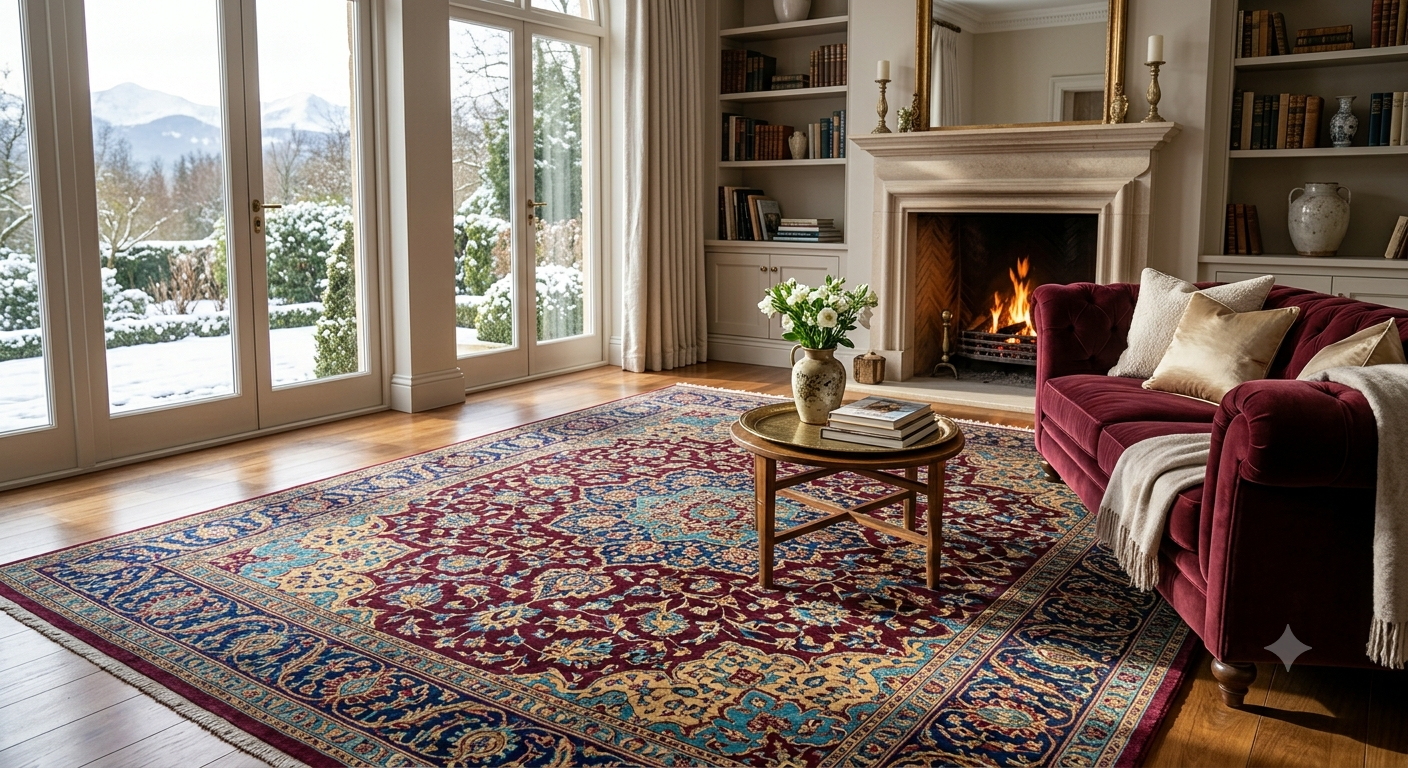
Imagine walking into a room where the floor itself seems to glow — where intricate floral patterns shimmer with a luminous sheen, changing character as the light moves across the surface. This is the magic of a hand knotted Kashmiri silk carpet, the pinnacle of carpet artistry and one of the most coveted luxury investments in the world.
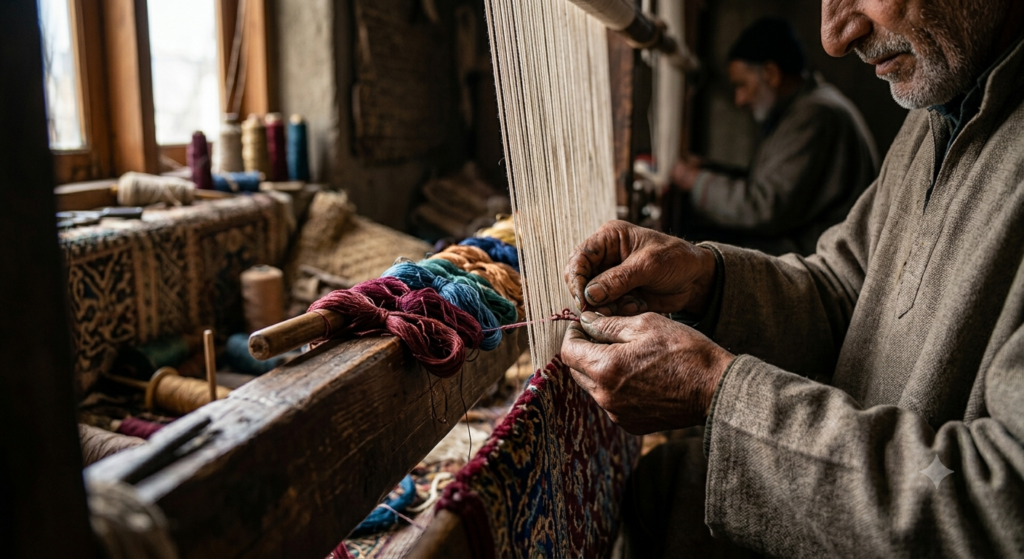
Kashmiri silk carpets enjoy a special place of pride in the handicraft industry worldwide . Renowned for their exquisite beauty, rich coloring, and exceptional quality, these carpets are masterpieces of human skill and patience . A single carpet can take 10 to 14 months to complete, with each knot tied by hand using techniques passed down through generations .
Hand-knotted rugs from Kashmir are made out of natural mulberry silk and feature intricate designs that are primarily oriental and floral in style . Kashmir rugs are renowned for bright, jewel-like color tones such as sapphire blue, ruby red, emerald green, aquamarine, amethyst, and ivory .
This guide will take you on a journey through the world of the hand knotted Kashmiri silk carpet, exploring its rich history, intricate craftsmanship, design elements, pricing, and how to identify authentic pieces.
Table of Contents
- ✅ What makes a hand knotted Kashmiri silk carpet so exceptional — and why they are worth the investment
- ✅ The rich history and the unique Taleem system that sets Kashmiri weaving apart
- ✅ Design motifs, colors, and the symbolism woven into every carpet
- ✅ Knot density, materials, and what determines quality and value
- ✅ How to identify authentic hand knotted silk carpets and avoid clever imitations
- ✅ Current pricing and where to buy genuine pieces
Quick Reference – Hand Knotted Kashmiri Silk Carpet at a Glance
What Makes a Hand Knotted Kashmiri Silk Carpet Exceptional?
The Silk Factor
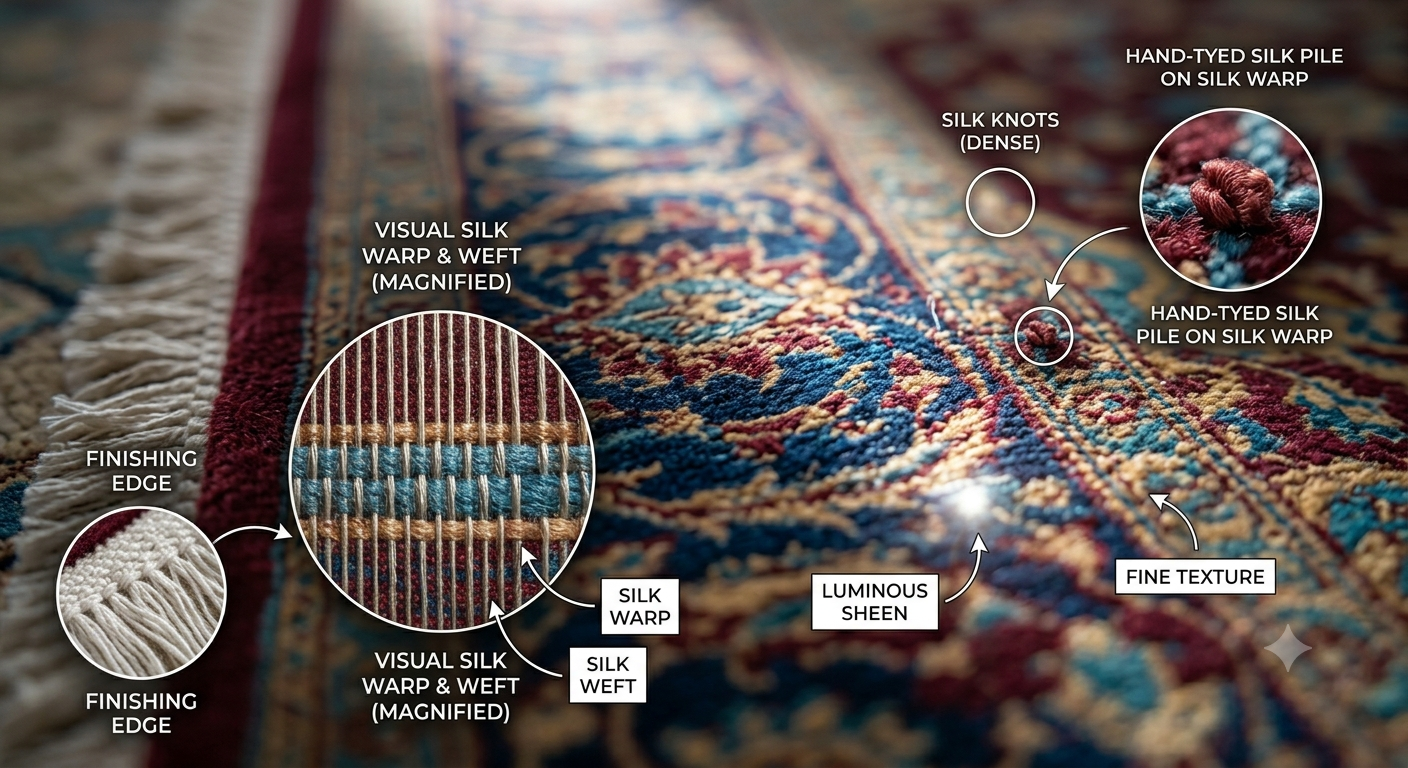
A hand knotted Kashmiri silk carpet is woven from natural mulberry silk, a fiber so fine and strong that it allows for extraordinary detail and a luminous sheen . Silk is an exclusive natural fibre that provides a soft and shiny feeling to rugs . Elegant rugs with rich details can only be made with silk because other fibres are too thick for this purpose .
Kashmiri silk carpets are hand-knotted in India, modelled on traditional Persian carpets, featuring oriental patterns consisting of medallions and repeating patterns, with the typical garden motif . The carpets are very high quality and, thanks to the choice of silk, they are thin and light, with a beautiful shimmering lustre . Using silk also makes detailed patterns possible, and the precision in the work behind the carpet is impressive .
The Knotting Technique
Kashmiri carpets are always knotted, never tufted . The pile weaving uses the Farsi baff, the Persian system known as Sehua, Sinneh or asymmetrical knot, which opens to the left . This asymmetrical knot technique was introduced in Kashmir in the 15th century by Zain-ul-Abidin, the ruler popularly called Budshah, who brought artisans from Persia and Central Asia to train Kashmiri artisans .
The fineness of carpets is indicated by the number of knots woven per square inch (KPSI). The knot count is denoted numerically as 20/20 or 20X20 in Kashmir, which indicates the number of knots per square inch — the first digit referring to knots across the width, the second indicating knots along the length .
The Taleem System – Kashmir’s Unique Innovation
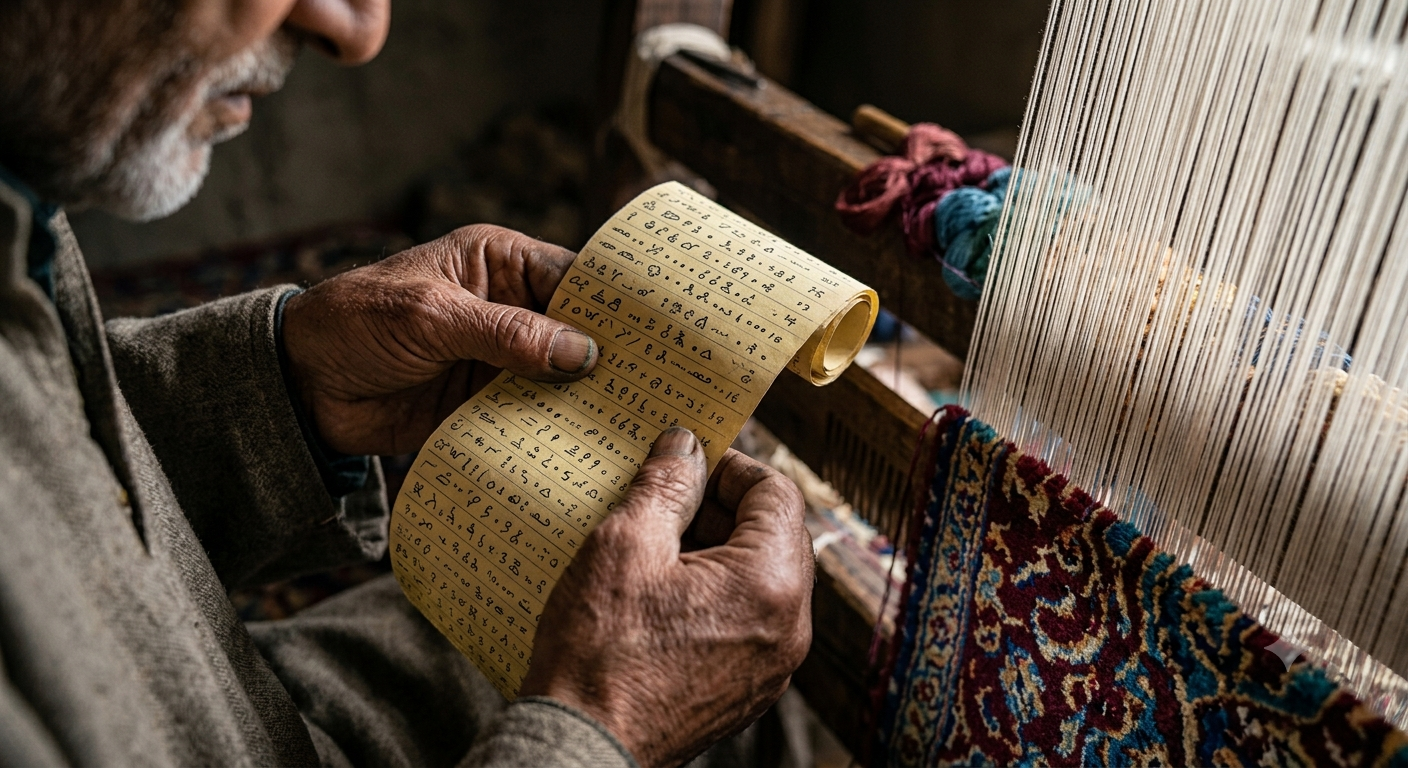
An integral component of Kashmiri carpet weaving distinct from Persian practices is the utilization of a coded syntax called the Taleem system . This system communicates knot by knot, row by row weaving instructions of the visual image for the entire carpet from the designer to the weaver through symbols, who then deciphers it for weaving the carpet .
The Taleem-system is recognized as a “sophisticated technology of great historical importance” and considered a “remarkable Kashmiri innovation” . As opposed to the cartoon style of weaving where the design is visible to the weaver, in the Taleem style of weaving, the design is not visible to the weaver until woven .
Design and Motifs of Kashmiri Silk Carpets
Framework of a Kashmiri Carpet
The Kashmiri Kaleen (carpet) is divided into three sections which form a framework for design development :
- Hashiya – The border of the carpet
- Kunjvat – The corners formed at the intersection of borders
- Mattan – The field of the carpet framed by the borders
Design Categories
Kashmiri carpet designs are categorized based on design features and symmetry :
| Design Category | Description |
|---|---|
| Dabdar | Boxed pattern design with individually framed boxes enclosing floral or plant motifs |
| Khaswann | All-over composition that is not repeated |
| Dajidar | All-over design with repeating motifs creating the pattern |
| Chand Chauthai | Central circular motif (moon) with decorated corners (quarters) |
| Mihrab | One-way arch pattern |
Common Motifs
Kashmiri silk carpets feature designs that reflect the natural beauty of Kashmir :
- Tree of Life – The most recurring motif found on silk carpets from Kashmir, depicted in all its glory
- Paisley – A culturally important motif rooted in Kashmiri tradition
- Chinar Tree – The oriental plane, symbolizing Kashmir’s natural heritage
- Hunting Scenes (Shikargarh) – Depicting regal hunting themes
- Bird and Animal Motifs – Representing life, vibrancy, and fertility
- Floral Medallions and Vines – Inspired by Persian and Mughal traditions
Colors and Palettes
Kashmiri rugs are renowned to have bright, jewel-like color tones such as sapphire blue, ruby red, emerald green, aquamarine, amethyst, and ivory . However, carpets from Kashmir are subtle in comparison with carpets produced from other parts of the country, as they are made with yarn dyed with mineral colors — vegetable dyes are not used at all .
Understanding Knot Density and Quality
Knot Density (KPSI)
The durability as well as the price of a carpet depends upon its knotting. The more knots per square inch, the higher will be the carpet’s price as well as durability .
Kashmiri weavers weave carpets in qualities varying from 18×18 KPSI to 30×30 KPSI and higher . The density of knots determines the extent of intricacy and detail that can be achieved in weaving . For example, a hand knotted Kashmiri silk carpet may have a knottage of 24×24 (576 KPSI) to 28×28 (784 KPSI) .
Single vs Double Knots
There are both single and double-knotted carpets. You can quite easily identify one from the other on the reverse of the carpet :
- A single knotted carpet is fluffier and more resistant to the touch than a double knotted one .
- A double-knotted carpet has a pile that bends when brushed one way, and stands upright when brushed in another direction .
Pricing Guide – Hand Knotted Kashmiri Silk Carpet
Price per square foot: A hand knotted Kashmiri silk carpet typically costs around ₹4,500/sq ft ($54/sq ft) at retail . Higher knot densities and pure silk constructions command premium pricing.
Pro Tip: A 100% pure silk carpet has very high knotage per inch, ranging between 400-1600 knots per square inch. This high percentage of knottage ensures the life and durability of these carpets .
How to Identify an Authentic Hand Knotted Kashmiri Silk Carpet
Step 1: Check the Construction Technique
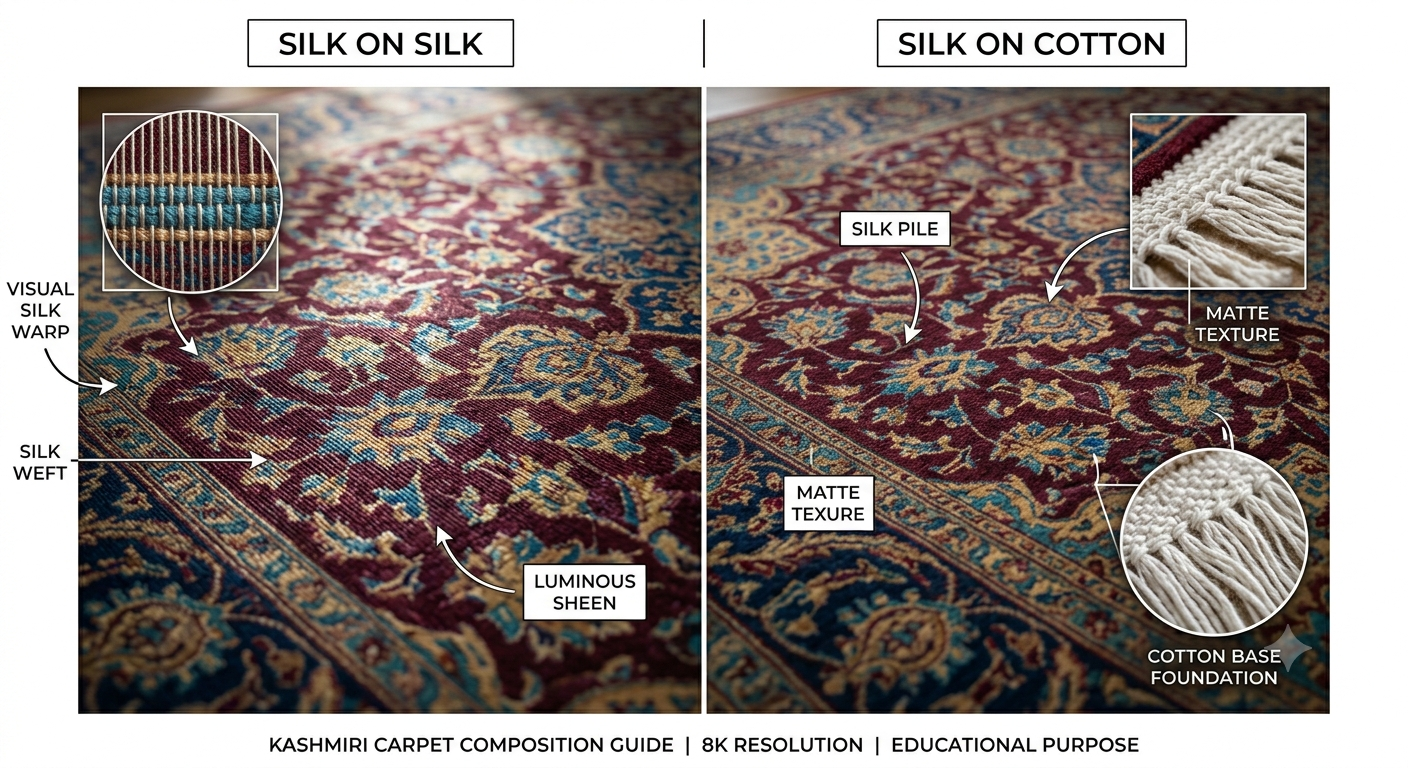
A Handmade silk carpet is woven in the hand-knotted technique. It takes many months, and some could take more than one year to complete . There are two types of silk carpets: Silk on Silk (warp and weft both in pure silk) and Silk on Cotton (pile is silk but warp is cotton) . A pure silk rug will have a high knot count — at least 500 knots per square inch, and most will have more .
Step 2: Examine the Reverse Side
Count the number of knots on the reverse of the carpet in any one square inch — it should be roughly the same as the dealer tells you, give or take 10 knots . If your count indicates about 10 less, it simply means the weft has not been evenly combed down in parts — this is not a fault, and several random checks throughout the carpet will even go above the figure of the dealer’s estimate .
Step 3: Check the Material
Pure silk is light as a feather but strong as steel — it is world renowned as the most luxurious and fine material on the planet . If you want to check that the carpet is in pure silk or artificial silk, pull a thread from the carpet and burn it. If the burnt yarn smells like burnt hair, it is a silk carpet .
Step 4: Examine Design Integrity
Look for:
- Whether any element in the design has been wrongly woven so that one motif is larger or smaller at one end than the corresponding motif at another end
- Whether each motif or element of design has clear, crisp outlines — blurred edges indicate a fault in the weaving
- Whether the edges of the carpet are crooked as if it had been incorrectly mounted on the frame
Step 5: Ask About Materials and Knot Count
Points to keep in mind when choosing a carpet:
- Whether it has been made of silk pile on silk base, silk pile on cotton base, silk and wool on cotton base, or wool on cotton base
- The number of knots on the reverse of the carpet
Step 6: Buy from a Trustworthy Source
A handmade silk area rug is costly, so never buy it from anywhere . Check customer reviews and feedback, ask how old the company is, and ensure you are 100% satisfied before making a purchase .
Frequently Asked Questions
What is a hand knotted Kashmiri silk carpet?
A hand knotted Kashmiri silk carpet is a luxury floor covering woven by skilled artisans in the Kashmir Valley using natural mulberry silk. Each carpet is tied knot by knot using the asymmetrical Persian knot (Farsi baff) technique, with knot densities ranging from 400 to 1600+ knots per square inch . Browse our Kashmiri carpet collection to see examples.
How can I tell if a Kashmiri silk carpet is authentic?
Check for hand-knotted construction with visible knots on the reverse side, perform the burn test (pure silk smells like burnt hair), examine for clear, crisp design outlines, and verify the knot density (minimum 400 KPSI for quality silk) .
How much does a hand knotted Kashmiri silk carpet cost?
Prices range from $175 for a small 2×3 ft carpet to $12,000+ for a large 9×12 ft pure silk piece. Per square foot pricing starts around ₹4,500 ($54) for silk-on-cotton carpets. Higher knot densities and pure silk (silk-on-silk) construction command premium prices .
What is the difference between silk on silk and silk on cotton?
Silk on silk uses silk for both the pile and the foundation (warp and weft) — these are the most expensive and luxurious . Silk on cotton uses silk for the pile but cotton for the foundation, offering a balance of quality and cost .
What is the Taleem system in Kashmiri carpet weaving?
The Taleem is a coded cryptographic script unique to Kashmiri carpet weaving. It communicates knot by knot, row by row weaving instructions through symbols — one denoting color, the other denoting knot count . Unlike Persian carpets where the weaver can see the design, in the Taleem system, the design is not visible until it is woven. It is considered a “remarkable Kashmiri innovation” .
What are the common designs and motifs in Kashmiri silk carpets?
Common motifs include the Tree of Life, paisley, Chinar tree, floral medallions, and hunting scenes . Design categories include Dabdar (boxed pattern), Khaswann (non-repeating), Dajidar (repeating motifs), Chand Chauthai (moon and quarters), and Mihrab (prayer arch) .
How long does it take to weave a hand knotted Kashmiri silk carpet?
A hand knotted Kashmiri silk carpet typically takes 10 to 14 months to complete, depending on the knot density and design complexity . Exceptional pieces with high KPSI can take even longer.
Do you ship hand knotted Kashmiri silk carpets internationally?
Yes. At Sonzal the Rainbow, we ship authentic hand knotted Kashmiri silk carpets worldwide with full insurance and tracking. Contact us for a custom quote.
Conclusion
A hand knotted Kashmiri silk carpet is more than just a floor covering — it is a masterpiece of human artistry, a piece of living heritage, and an investment that can appreciate over time. Each carpet carries the story of the artisans who wove it, the culture that shaped it, and the centuries of tradition that make it exceptional.
Three key takeaways:
- ✅ Kashmiri silk carpets represent the pinnacle of carpet artistry. With knot densities ranging from 400 to 1600+ KPSI and the unique Taleem system, these carpets are among the finest in the world .
- ✅ Authenticity is in the details. Look for hand-knotted construction with visible knots, natural mulberry silk (burn test), clear design outlines, and a trustworthy dealer .
- ✅ You are investing in heritage. Each carpet takes 10-14 months to complete, supporting skilled artisans and preserving a centuries-old craft . When you buy a hand knotted Kashmiri silk carpet, you are investing in a heirloom that can be treasured for generations.
Every genuine hand knotted Kashmiri silk carpet is one of a kind — the combination of natural dye variations, artisan skill, and handcrafted precision ensures that no two carpets are exactly alike. If you find one you love, do not wait.
Ready to Find Your Perfect Hand Knotted Kashmiri Silk Carpet?
Oman Contact: +96891179269 | +96876450569
India Contact: +919811449221 | +919718122866
