
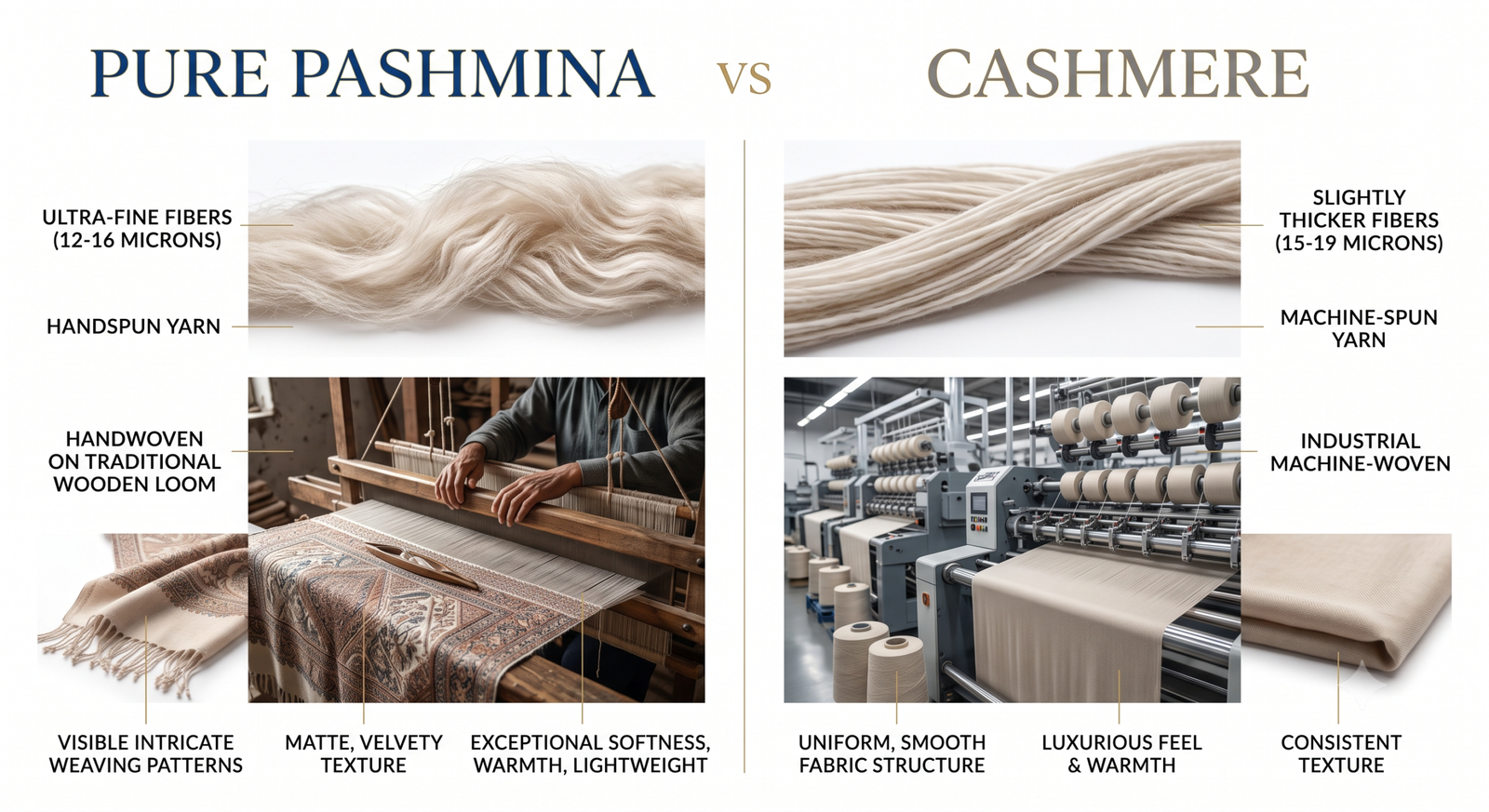
Cashmere vs Pashmina – What’s the Real Difference? Your Complete Guide to Luxury Fibers
Imagine wrapping yourself in a shawl so soft it feels like a whisper against your skin — lightweight yet impossibly warm, delicate yet enduring. This is the promise of luxury fibers like cashmere and pashmina. But when it comes to the difference between cashmere and pashmina, the lines often blur, leaving buyers confused and uncertain.
You walk into a boutique and see a scarf labeled “100% Pashmina.” Next door, a similar item is marked “Pure Cashmere.” Both are soft. Both are warm. Both are expensive. Are they the same thing? Is one better than the other? How can you tell if you are paying for genuine quality or a clever marketing label?
These are questions that confound even seasoned luxury shoppers. The global market is flooded with products claiming to be cashmere or pashmina, but many are blends, imitations, or mislabeled goods that fall far short of the real experience.
This guide will demystify the difference between cashmere and pashmina once and for all. Drawing on decades of expertise from Sonzal the Rainbow — a trusted name in authentic Kashmiri handicrafts — we will take you through the history, origins, fiber characteristics, craftsmanship, and value of these two remarkable materials.
Table of Contents
Here is what you will learn:
- ✅ The actual difference between cashmere and pashmina — and why the terms are often confused
- ✅ The origin story of each fiber — where they come from and why it matters
- ✅ Fiber quality comparison — diameter, warmth, weight, and durability
- ✅ Craftsmanship differences — hand-spun vs machine-made
- ✅ Pricing insights — what you should expect to pay for authentic pieces
- ✅ Expert tips to identify genuine pashmina and cashmere
Quick Answer: The difference between cashmere and pashmina comes down to fiber fineness, origin, and craftsmanship. Both come from the same type of goat, but pashmina refers specifically to the ultra-fine undercoat of the rare Changthangi goat from Ladakh — with fibers measuring 12-16 microns — hand-spun and handwoven in Kashmir. Cashmere is a broader term for the same type of wool, with fibers ranging from 12-21 microns, often machine-processed and sourced from multiple regions.
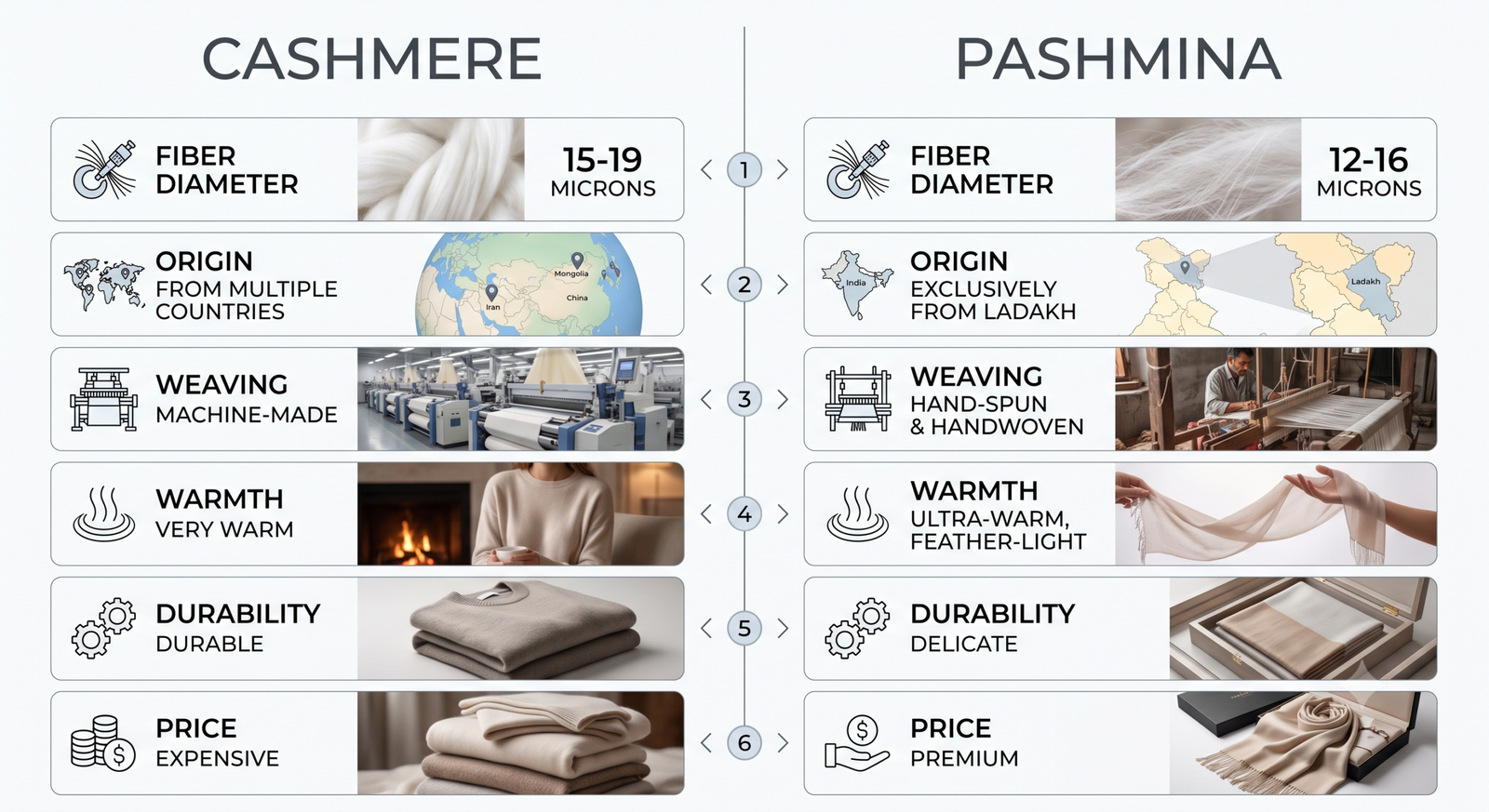
Quick Reference – Cashmere vs Pashmina at a Glance
The Story Behind the Fibers
What is Cashmere?
Cashmere is a luxurious natural fiber obtained from the soft undercoat of cashmere goats (Capra hircus), which grow a fine, warm underlayer to survive harsh winters in cold, mountainous regions. These goats are found primarily in China, Mongolia, Iran, and India, with the finest quality coming from the high-altitude regions of Ladakh.
The goats naturally shed their undercoat each spring, and the wool is carefully collected through gentle combing — a process that does not harm the animals. Each goat produces only 150-200 grams of usable cashmere per year, contributing to the fiber’s rarity and premium status.
The fiber diameter of cashmere typically ranges from 14 to 19 microns, though it can be as fine as 12 microns or as coarse as 21 microns depending on quality. This extraordinary fineness gives cashmere its signature softness, lightweight warmth, and breathability — making it highly prized in luxury fashion.
What is Pashmina?
Pashmina is often described as “the finest version of cashmere” — or, as some call it, “soft gold” and “diamond fiber.” The word comes from the Persian word “pashm,” meaning wool.
Pashmina wool is exclusively sourced from the rare Changthangi goats (also known as the Pashmina goat) — a breed native to the high plateaus of Ladakh in northern India, living at altitudes above 14,000 feet. The extreme cold forces these goats to grow an exceptionally fine, dense undercoat. These goats constitute only 0.01% of the world’s cashmere-producing goat population, making pashmina exceptionally rare.
The fiber diameter of pure pashmina ranges from 12 to 16 microns — finer than most cashmere and thinner than human hair. This ultra-fineness gives pashmina its legendary softness and feather-light feel.
A Brief History
Pashmina has been prized for centuries. Samples of pashmina wool fibers recovered from the ancient Indus Valley Civilization at Harappa suggest the material has been valued for over 4,000 years. In Mughal times, pashmina shawls were used as indicators of rank and nobility.
The Kashmir shawl — woven from pashmina — became globally renowned, and the craft was traditionally passed down through generations of Kashmiri artisans. Pashmina gained international fame when Kashmiri carpets and shawls were displayed at the Crystal Palace in London in 1851.
Today, both cashmere and pashmina continue to represent the pinnacle of luxury textiles, but the difference between cashmere and pashmina lies in the details.

Key Differences: Cashmere vs Pashmina
1. Fiber Diameter – The Micron Difference
The most fundamental difference between cashmere and pashmina lies in the fineness of the fiber, measured in microns.
Pashmina fibers are among the finest in the world. This extreme fineness is what gives pashmina its unparalleled softness, lightness, and warmth-to-weight ratio.
2. Origin – Where the Goats Live
Both fibers come from goats, but not just any goats.
- Cashmere is sourced from various cashmere goat breeds found across China, Mongolia, Tibet, Iran, and India.
- Pashmina comes exclusively from the Changthangi goat breed in the Ladakh region of India, living at altitudes above 14,000 feet.
The extreme cold of Ladakh forces these goats to develop an ultra-fine undercoat that is unmatched in quality.
3. Craftsmanship – Hand vs Machine
Cashmere can be machine-spun and machine-woven, especially in mass-market products.
Pashmina, in contrast, is traditionally hand-spun and handwoven by skilled Kashmiri artisans using centuries-old techniques. The entire process — from cleaning to spinning to weaving — is done manually without the use of machinery.
Insider Tip: “A fine pashmina has a particular kind of softness: not slippery, not overly fuzzy, not ‘blanket-like.’ Instead it is smooth, refined, and warm with surprising lightness.”
4. Warmth and Weight
Pashmina is lighter and warmer than cashmere, gram for gram. The ultra-fine fibers trap more heat while weighing less, creating a “feather-light warmth” that is unmatched.
Cashmere is also warm and lightweight but tends to be slightly heavier and less delicate.
5. Durability
Cashmere is more durable and suitable for everyday wear, including sweaters, scarves, and blankets.
Pashmina is more fragile and delicate, best reserved for luxury shawls, stoles, and special occasions.
6. Price
Both are expensive, but pashmina commands a premium price due to its rarity, finer fibers, and handcrafted production.
| Quality | Typical Price Range (USD) |
|---|---|
| Standard cashmere scarf | $100 – $300 |
| High-quality cashmere shawl | $300 – $600 |
| Pure pashmina shawl (handwoven) | $150 – $800+ |
| Premium pashmina (Kani weave) | $500 – $1,500+ |
How to Identify Authentic Pashmina
With so many products labeled “pashmina,” knowing how to identify the real thing is essential. Here is a checklist to help you verify authenticity:
Step 1: Check the Origin
Genuine pashmina comes from Ladakh, India. If a product claims to be pashmina but originates from elsewhere, be cautious.
Step 2: Perform the Touch Test
Pure pashmina feels ultra-soft, smooth, and refined — not slippery, not overly fuzzy, and not “blanket-like.” It should feel feather-light in your hands.
Step 3: Look for Handcrafted Details
Authentic pashmina is hand-spun and handwoven. Look for slight irregularities in the weave — these are signs of handcraftsmanship, not flaws. Machine-made products will have perfectly uniform patterns.
Step 4: Check the Price
If a “pashmina” shawl costs less than $100, it is almost certainly a blend or imitation. Genuine pashmina requires months of labor and rare materials.
Step 5: Request Certification
Reputable sellers like Sonzal the Rainbow provide certificates of authenticity. Look for GI tags (Geographical Indication) that verify genuine Kashmiri origin.
Step 6: Perform the Burn Test
Pure pashmina (animal fiber) burns like hair — it curls, smells like burnt feathers, and turns to ash. Synthetic fibers melt and smell like burning plastic.
Which One Should You Choose?
Choose Cashmere If:
- You want a durable, versatile luxury fiber for everyday wear
- You prefer a slightly thicker, more substantial fabric
- You are looking for sweaters, blankets, or scarves for regular use
- You want a more affordable entry point into luxury fibers
Choose Pashmina If:
- You want the finest, softest, most luxurious fiber available
- You appreciate handcraftsmanship and centuries-old artisanal techniques
- You are looking for an investment piece — wearable art that can be treasured for generations
- You value rarity and exclusivity — only 0.01% of goats produce this fiber
- You want a feather-light shawl that provides exceptional warmth without weight
Insider Tip: “Pashmina is the art of handcrafting luxury shawls, scarves, and wraps from Cashmere. Cashmere is the fine animal hair growing on the body of the Himalayan Capra Hircus.” All pashmina is cashmere, but not all cashmere is pashmina.

Frequently Asked Questions
What is the main difference between cashmere and pashmina?
The main difference between cashmere and pashmina lies in fiber fineness, origin, and craftsmanship. Pashmina fibers measure 12-16 microns and come exclusively from Changthangi goats in Ladakh, India, and are hand-spun and handwoven. Cashmere fibers measure 14-19 microns and come from various regions, often machine-processed.
Which is better – cashmere or pashmina?
Neither is inherently “better” — they serve different purposes. Pashmina is finer, softer, lighter, and warmer per gram, but more delicate and expensive. Cashmere is more durable, versatile, and affordable. The choice depends on your needs: everyday wear vs special occasions, investment vs practicality.
Why is pashmina more expensive than cashmere?
Pashmina is more expensive because of its rarity (only 0.01% of cashmere-producing goats are Changthangi), finer fibers (12-16 microns), and labor-intensive handcrafting process (hand-spun and handwoven by skilled artisans). Browse our pashmina shawl collection to see authentic examples.
How can I tell if a pashmina shawl is authentic?
Look for: (1) Ladakh origin, (2) ultra-soft, feather-light feel, (3) handcrafted irregularities in the weave, (4) reasonable price (not under $100), (5) certificate of authenticity or GI tag, and (6) burn test results (burns like hair, not plastic).
Is pashmina warmer than cashmere?
Yes. Pashmina provides more warmth per gram than cashmere due to its finer fibers, which trap more heat while weighing less. Pashmina feels feather-light yet provides exceptional insulation — a hallmark of its superior quality.
What is the fiber diameter of pashmina vs cashmere?
Pashmina fibers are 12-16 microns. Cashmere fibers are 14-19 microns, though they can range from 12-21 microns depending on quality.
Can I wear pashmina every day?
Pashmina is more delicate than cashmere and is best reserved for special occasions or careful use. For everyday wear, cashmere is more durable and practical.
How should I care for my pashmina shawl?
Dry clean or hand wash in cold water with mild shampoo. Never wring or twist. Lay flat to dry away from direct sunlight. Store in a breathable cotton bag with cedar balls to prevent moth damage.
Conclusion
Understanding the difference between cashmere and pashmina is the first step toward making an informed luxury purchase. Both fibers are extraordinary in their own right, but they offer distinctly different experiences.
Three key takeaways:
- ✅ Pashmina is the finest form of cashmere. While both come from goats, pashmina comes from the rare Changthangi goat breed in Ladakh, with fibers measuring 12-16 microns — finer and softer than standard cashmere.
- ✅ Craftsmanship sets pashmina apart. Pashmina is hand-spun and handwoven by skilled Kashmiri artisans using centuries-old techniques, making each piece a work of wearable art.
- ✅ Choose based on your needs. Cashmere offers durability and versatility for everyday wear, while pashmina offers unmatched luxury, warmth, and rarity for special occasions and investment pieces.
Every genuine pashmina shawl is a piece of living heritage — crafted by artisans who have inherited skills passed down through generations. When you buy authentic pashmina, you are not just buying a shawl. You are preserving a centuries-old craft and supporting the communities that keep it alive.
Ready to Find Your Perfect Pashmina Shawl?
Oman Contact: +96891179269 | +96876450569
India Contact: +919811449221 | +919718122866
