

Buying a Kashmiri carpet in 2026 requires more than an eye for beauty; it requires a “technical audit.” With the rise of “art silk” (viscose) and “bamboo silk,” even experienced designers can be misled. To ensure your piece is a genuine, hand-knotted treasure, you must master the three pillars of authenticity: The Fiber, The Density, and The Registry.
1. The Burn Test: Science vs. Synthetics
The most reliable way to distinguish real vs. artificial silk rugs remains the “Burn Test.” Genuine silk is a protein fiber (mulberry silk), while fakes are typically cellulose-based (rayon) or petroleum-based (polyester).
- The Method: Extract a single tiny strand from the fringe or the pile. Hold it with tweezers and ignite it with a lighter.
- The Result of Authentic Silk: It will shrivel away from the flame, smell distinctly like burnt hair, and leave a soft, black, powdery ash that pulverizes instantly when touched.
- The Result of Artificial Silk: Viscose/Rayon will smell like burnt paper and leave a fine white ash. Synthetics like polyester will melt into a hard plastic bead and emit a chemical odor.

2. KPSI: The “Resolution” of a Masterpiece
In the world of luxury rugs, KPSI (Knots Per Square Inch) is the ultimate metric of value. Just as a higher pixel count makes a digital image sharper, a higher KPSI allows for the fluid, curvilinear designs characteristic of Srinagar’s master weavers.
- Low Quality (Under 200 KPSI): Often wool-based or entry-level silk; designs appear “blocky.”
- Collector Grade (400–600 KPSI): The standard for authentic Kashmiri silk. The design flows like a painting.
- Investment Grade (700–1000+ KPSI): Rare masterpieces that take years to weave. These are often used as wall hangings because the pile is as thin as parchment.
Pro Tip: Turn the carpet over. On an authentic Kashmiri silk carpet, the pattern should be as clear on the back as it is on the front. If the back looks fuzzy or lacks detail, the knot density is low.

3. The 2026 Standard: The GI Tag & QR Code
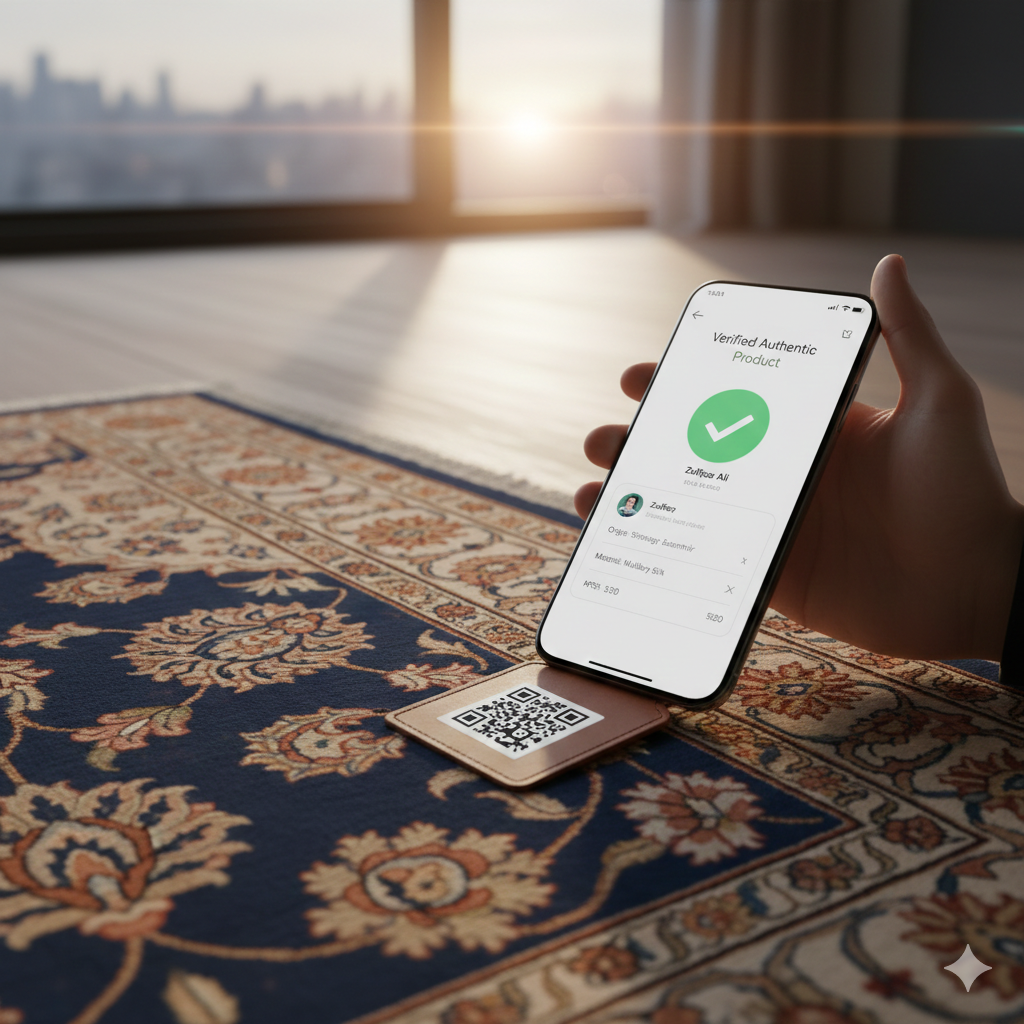
The most significant advancement in 2026 is the Geographical Indication (GI) Tag. This is the only government-backed certification that guarantees a carpet was hand-knotted in the Kashmir valley.
- Look for the Label: Genuine carpets now feature a secure, non-transferable GI label with a unique QR code.
- Digital Verification: Scanning the code with your smartphone reveals the weaver’s name, the district of origin, the material used, and the verified KPSI.
If a seller claims a rug is “Kashmiri” but cannot produce a GI-certified QR code, you are likely looking at a “Kashmir-style” rug made elsewhere.
4. The “Luster Shift” Test
Authentic mulberry silk has a unique molecular structure that reflects light differently from every angle.
- The Test: Stand at one end of the rug; the colors should appear rich and deep. Walk to the opposite end and look back; the rug should appear significantly lighter and more silvery. This “color flip” is a hallmark of premium hand-knotted silk.

Summary Checklist for 2026 Buyers
| Feature | Authentic Kashmiri Silk | Artificial/Machine Made |
| Burn Test | Smells like burnt hair; soft ash | Smells like paper/plastic; hard bead |
| Back of Rug | Mirror image of the front; visible knots | Fuzzy, covered by cloth, or perfectly “flat” |
| Fringe | Integrated (extension of the warp) | Sewn on or glued to the edge |
| Certification | GI Tag with scannable QR Code | Missing or generic “Handmade” sticker |
