
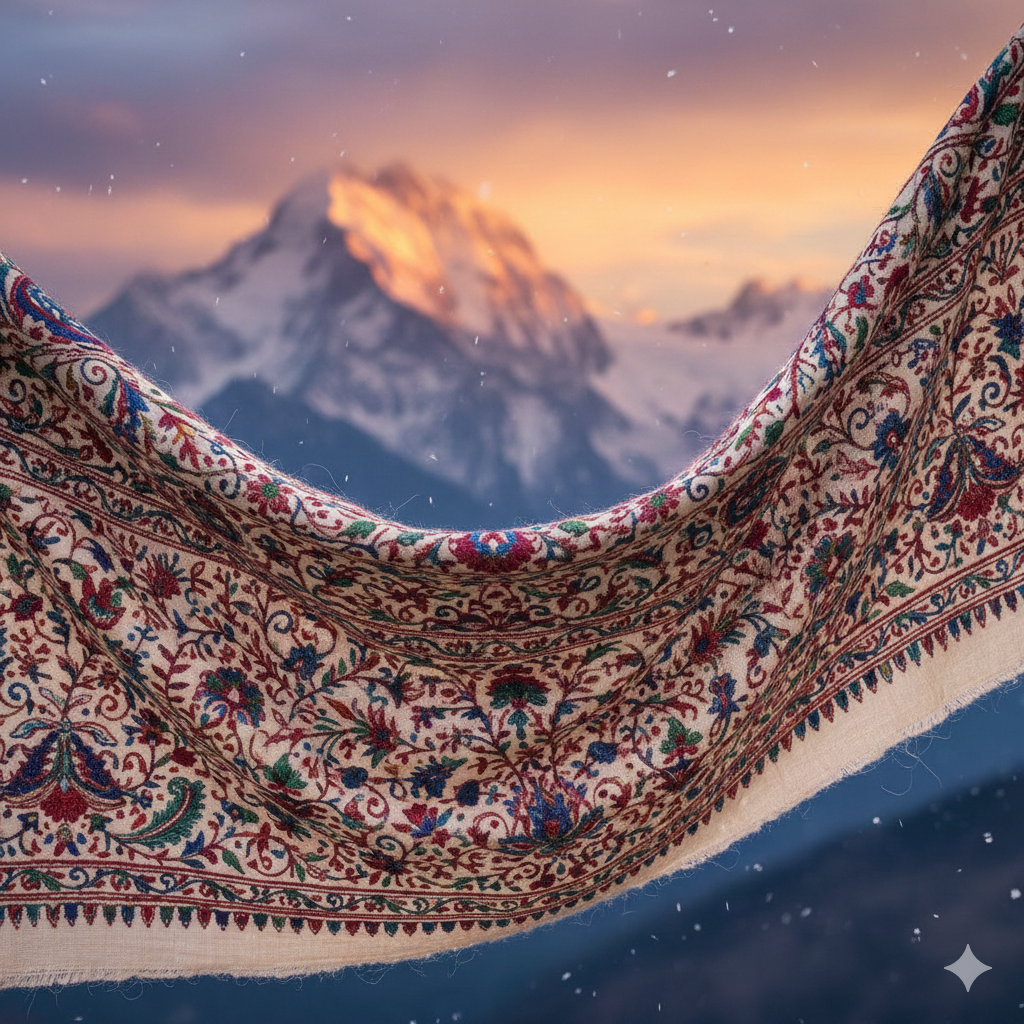
There is a fabric so fine, so ethereal, that it has been woven into the very soul of luxury and romance for centuries. It is a whisper from the high Himalayas, a story spun from the cold, thin air of the Changthang plateau. This is not just a shawl; this is Kashmir Pashmina.
To call Pashmina a mere fashion accessory is to call the Himalayas mere hills. It is an heirloom, a piece of wearable art, and a testament to human patience and craftsmanship that has endured for over 600 years.
Where Does the Magic Begin? With the Changra Goat.
The journey of every genuine Pashmina begins at a breathtaking altitude of 14,000 feet in Ladakh, with a special breed of goat: the Changthangi or Changra goat. To survive the brutal winters, where temperatures plunge to -40°C, these goats grow an incredibly soft, warm undercoat. This downy fleece, shed naturally every spring, is what we know as Pashm (the Persian word for “soft gold”).
This raw Pashm is collected through a painstaking process of combing, not shearing, ensuring the fibers remain long and intact. It is this raw material, scarce and precious, that forms the foundation of the legend.
The Artistry: From Fleece to Fantasy
Once the raw Pashm reaches the valleys of Kashmir, it enters the hands of master craftsmen, where it undergoes a transformation that is nothing short of alchemy.
- Spinning: The delicate fibers are spun by hand onto a wooden wheel called a yinder. This is often done by women, whose skilled hands create a yarn so fine it is almost invisible. This step alone can take days for a single shawl.
- Weaving: The spun yarn is then woven on traditional handlooms (karkhanas). The most basic plain weave Pashmina is light as a cloud. But the true magic lies in its famed embellishments:
- Kani Weaving: An ancient, intricate technique where patterned shawls are woven using small wooden sticks called Tujis or Kanis. Each stick carries a different colored thread, following a coded pattern called Talim. A single Kani shawl can take over a year to complete.
- Sozni Embroidery: The art of delicate, almost microscopic embroidery, usually done in silk thread. Master embroiderers create breathtaking floral motifs (buta, paisley) so fine that the embroidery seems to float on the surface of the shawl.
- Paper Mache & Aari Work: Other exquisite forms of needlework that add vibrant, textured designs to the soft base.
Why is Pure Pashmina So Special?
- Unmatched Softness & Warmth: The fiber is microns finer than human hair, making it luxuriously soft against the skin. Its unique structure creates tiny air pockets, providing exceptional insulation without weight.
- Light as a Breeze: A full-sized Pashmina shawl can be passed through a wedding ring—a traditional test of its fineness.
- A Legacy in Every Thread: Each piece carries the breath of the artisan, the history of a region, and the patience of months, sometimes years, of dedicated work.
Navigating the World of Pashmina: A Buyer’s Note
With popularity comes imitation. Here’s how to seek authenticity:
- Understand Terminology: “Pashmina” often refers to the material (Pashm wool). A 100% Cashmere Pashmina is pure and luxurious. Many beautiful shawls are a 70% Pashmina, 30% Silk blend, which adds sheen and durability.
- The Feel & Test: Genuine Pashmina is incredibly soft, not scratchy. It is warm to the touch and has a subtle, matte finish (unless blended). The “ring test” is a classic, though not always practical in a store.
- Price is a Pointer: Authentic, handcrafted Pashmina is an investment. If the price seems too good to be true, it likely is.
- Trust & Traceability: Buy from reputed, ethical sellers who can explain the origin and make of the shawl. Look for craftsmanship, not just a label.
More Than a Shawl: A Cultural Tapestry
Kashmir Pashmina is not just an object; it is a narrative. It’s the story of nomadic herders in Ladakh, of artists whose families have woven for generations, and of a region whose identity is intricately linked to this craft. It has adorned Mughal emperors, French royalty, and continues to be a symbol of timeless elegance today.
To own a piece of Kashmir Pashmina is to own a fragment of this enduring legend—a whisper of the mountains, woven with patience, and destined to become a legacy.
Have you ever felt the magic of a true Pashmina? Share your thoughts or stories in the comments below.
Love for craftsmanship? Subscribe for more deep dives into the world of heritage arts and sustainable luxury.
