
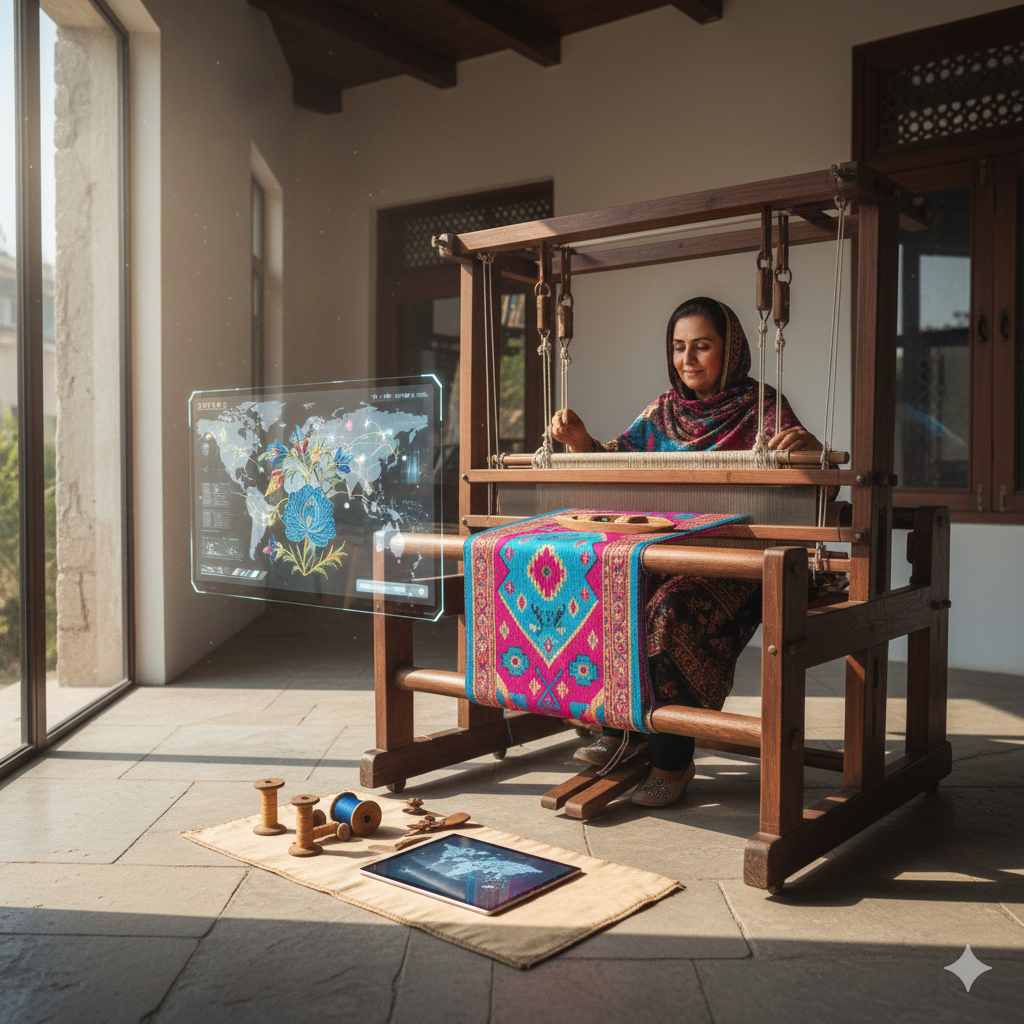
For centuries, the arts of Kashmir have spoken a universal language of beauty. The whisper of Pashmina, the poetry of Sozni needlework, the glow of Papier-mâché, and the shimmer of Kani weaving have traversed the Silk Road and graced royal courts. But in today’s hyper-globalized, digital world, what is the future of these ancient crafts? The path forward isn’t about mere survival—it’s about a bold, strategic reinvention that positions Kashmiri artistry as a vital, sustainable pillar of global luxury and conscious culture.
The Challenge: A Crossroads in the 21st Century
The threats are well-known: generational attrition, as master artisans age with few successors; fast-fashion plagiarism, which devalues authentic work; complex supply chains that marginalize creators; and a disconnect between traditional motifs and contemporary global aesthetics.
Yet, within these challenges lie unprecedented opportunities. The global consumer is evolving. There is a growing hunger for authenticity, sustainability, and meaningful provenance—values that are the innate DNA of Kashmiri craft.
The Blueprint: Four Pillars for a Global Future
1. The Narrative Revolution: From Product to Provenance
The future belongs to storytellers. The global market no longer just buys a shawl; it invests in a story.
- Action: Leverage digital media to showcase the journey—the Changthangi herder on the plateau, the spinner’s rhythm, the weaver’s focus, the embroiderer’s silent years. Blockchain and QR-code linked digital passports can trace a product’s origin, embedding immutable provenance. The story becomes a core part of the product’s luxury.
2. The Design Dialog: Fusing Heritage with Contemporary Voice
Tradition must converse with the present. This isn’t dilution; it’s evolution.
- Action: Foster structured collaborations between Kashmiri master artisans and global designers, architects, and luxury brands. Imagine:
- Pashmina reimagined in minimalist silhouettes for modern tailoring.
- Sozni motifs abstracted for contemporary home decor and high-end tech accessories.
- Walnut wood and Papier-mâché techniques applied to modern furniture and lighting.
- Crewel embroidery (Aari) patterns translated into bold, graphic statements.
3. The Digital Atelier: Democratizing Access & Empowering Artisans
Technology is the bridge between the isolated valley and the world.
- Action:
- E-commerce Platforms: Move beyond generic marketplaces to curated, story-driven digital ateliers that connect artisans directly with global patrons.
- Virtual Craft Tours & Workshops: Use VR/AR to offer immersive experiences of the craft process, creating emotional connection and education.
- Digital Design Tools: Empower artisans with tablets and software to visualize new patterns and co-create with clients remotely, reducing waste and increasing customization.
4. The Sustainability Standard: Leading the Ethical Luxury Movement
Kashmir’s crafts are inherently sustainable—handmade, biodegradable, and low-waste. This must become its central, marketable virtue.
- Action: Certify the entire ecosystem. Promote the “Farm-to-Fashion” or “Mountain-to-Mantle” narrative. Highlight the ethical treatment of goats, the natural dyes, the zero-electricity handlooms, and the craft’s role in preserving cultural biodiversity. Position it as the antidote to industrial fast fashion.
Vision 2030: What a Globally Integrated Kashmiri Craftscape Looks Like
- In Milan & Paris: A celebrated Kashmiri textile artist is a named collaborator on a major fashion house’s sustainable collection.
- In New York & Tokyo: A “Kashmir Contemporary” design gallery features limited-edition, co-created pieces where a Sozni artisan is credited as a co-designer.
- In London & Dubai: A luxury hotel’s interiors are adorned with bespoke, modern Papier-mâché installations and hand-worn copperware (Naqashi), commissioned directly from Kashmiri guilds.
- Online: A young consumer buys a Kani-woven laptop sleeve from a platform that shows her the weaver’s family story and the product’s carbon-negative footprint.
The Imperative: Collaboration & Institutional Will
This future cannot be built by artisans alone. It requires a synergistic ecosystem:
- Government & NGOs: To provide infrastructure, international marketing muscle, GI protection, and facilitate global trade fairs.
- Private Capital & Design Schools: To invest in innovation labs, fund designer-in-residence programs, and foster business acumen among artisans.
- Global Consumers: To become educated patrons, valuing time over trend, and choosing heirlooms over disposables.
Conclusion: Not a Relic, But a Renaissance
The future of Kashmir’s arts on the world stage is not about being preserved under glass. It is about being plugged into the global grid—respected for its past, but dynamically engaged with the present.
The raw materials are all there: unparalleled skill, timeless techniques, and a deep cultural reservoir. The task now is to build the new looms—the digital, collaborative, and narrative frameworks—on which the next chapter of this millennia-old story can be woven.
The goal is clear: to ensure that when the world thinks of ultimate luxury, human-centric sustainability, and living heritage, it thinks first of the arts of Kashmir.
What role do you see for traditional crafts in our global future? How would you reimagine a Kashmiri craft for a modern audience? Share your vision in the comments.
This is the third post in our series “Threads of Kashmir.” Read our deep dives on Pashmina and Sozni Art.
