
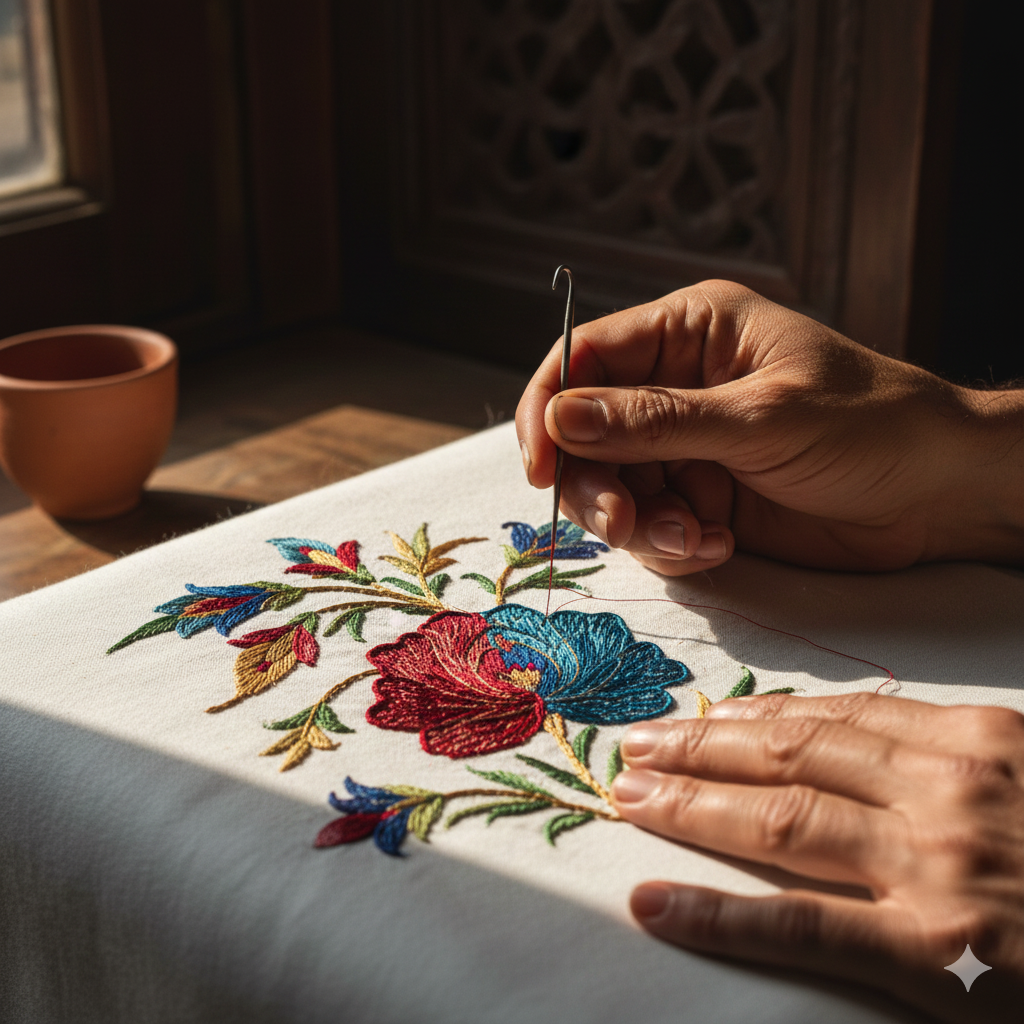
Hidden within the soft folds of a Kashmiri shawl is a universe of blossoms, vines, and motifs so fine they seem to have been breathed onto the fabric, not stitched. This is Sozni (or Suzani), the art of microscopic embroidery that doesn’t just decorate Pashmina—it elevates it to a canvas of living poetry. More than a craft, Sozni is the silent, beating heart of the Kashmir shawl industry, a thread connecting its glorious past to a fragile yet determined present.
The Art of “Less is More”: What is Sozni?
Unlike heavier embroideries, Sozni is defined by its delicacy and restraint. The word itself is believed to derive from the Persian Suzan, meaning “needle.” Its essence lies in invisibility.
- The Stitch: Artisans use a single-ply silk or fine cotton thread on a gossamer Pashmina or fine wool base. The primary stitch is the Sozni stitch—a small, flat, diagonal satin stitch that lies so perfectly flush with the fabric it is nearly undetectable from the back.
- The Motifs: The designs are predominantly floral—the iconic Kashmiri badaam (almond), chinar (maple leaf), and gulab (rose)—arranged in graceful, flowing patterns (pallav) along the borders or scattered (boota) across the field.
- The Magic: The true mastery is in the aari or hook needle, used in a tambour style. The artisan works from the underside of the fabric, creating designs on the front without ever seeing them directly—a feat of muscle memory and profound mental visualization.
A master Sozni artisan doesn’t embroider a pattern; they meditate it into existence. A single shawl, dense with this embroidery, can consume two to five years of a single craftsperson’s life.
The Implication: How Sozni Defines and Sustains the Industry
Sozni is not merely an add-on; it is a fundamental economic and cultural pillar of the shawl ecosystem.
1. The Ultimate Value-Adder:
While a plain Pashmina is precious, a Sozni-embroidered one is priceless. This embroidery multiplies the value of the base fabric exponentially. It transforms a luxury commodity into a unique, wearable heirloom, justifying the high price point that sustains the entire chain—from the Changthangi herder to the spinner, weaver, dyer, and embroiderer.
2. A Democratic Craft:
Sozni work is primarily done at home, often by women. This decentralized, cottage-industry model is crucial. It provides skilled employment within households, empowers female artisans financially, and keeps the craft alive within domestic spaces, passing seamlessly from one generation to the next. The shawl industry, therefore, is not confined to workshops but thrives in countless Kashmiri homes.
3. The Signature of Authenticity:
In a market flooded with cheap, machine-made imitations, a genuine, hand-done Sozni embroidery is the unforgeable signature of authenticity. It is the primary differentiator between a mass-produced “Pashmina-style” stole and a true Kashmiri masterpiece. For connoisseurs, it is the most important marker of legacy and luxury.
The Delicate Thread: Challenges and The Way Forward
Yet, this very lifeline faces severe threats that jeopardize the entire industry:
- The Crisis of Time vs. Price: The years of labor demanded by fine Sozni are at odds with a fast-fashion world. Younger generations are reluctant to invest a lifetime in a skill with diminishing monetary returns, leading to a critical shortage of master artisans.
- Machine & Chemical Assault: Power-looms and computer-generated embroidery can mimic Sozni patterns in minutes for a fraction of the cost. Worse is the scourge of “chemical Sozni“—where designs are printed or chemically burned onto the fabric and given a single stitch overlay to mimic real embroidery, deceiving buyers and devaluing the craft.
- Market Confusion & Appropriation: The misuse of the word “Sozni” on machine-made goods dilutes its meaning and makes it harder for genuine artisans to command their rightful price.
Embroidering the Future: What Can Be Done?
The survival of Sozni—and by extension, the high-end shawl industry—depends on conscious intervention:
- Education & Authentication: Buyers must be educated to look for the “invisible” backside and the subtle, imperfect beauty of handwork. Strong Geographic Indication (GI) tagging and storytelling that highlights the artisan are key.
- Direct Valorization: Platforms that connect artisans directly to global consumers ensure a fair wage, recognize the artist, and preserve the narrative of the craft.
- Innovation Within Tradition: Supporting artisans in creating contemporary, less time-intensive Sozni pieces for modern wardrobes (like smaller motifs on cuffs or collars) can open new markets without compromising the core technique.
- Institutional Support: Government and private grants for master artisans to train apprentices are essential to keep the knowledge chain from breaking.
Conclusion: More Than a Shawl, It’s a Soul
A Kashmiri shawl with Sozni is not a finished product; it is a document of time. Each stitch is a moment in an artisan’s life—a prayer, a worry, a hope, rendered in silk. To buy one is to become a custodian of this living history.
The implications are clear: without Sozni, the Kashmir shawl industry would lose its soul and its highest economic peak. Protecting this art is not about preserving a relic; it is about investing in a sustainable ecosystem of beauty, skill, and human patience in a hurried world. It is about ensuring that the invisible poetry continues to be written, one needle-prick at a time.
Do you own a piece with Sozni work? Can you spot the difference between hand-made and machine-made embroidery? Share your observations below.
Dedicated to the Sozni kar (Sozni artisans) of Kashmir, whose needles write silent sonnets on wool.
